Wedding Weather Backup Plan: Rain, Heat, Wind
An outdoor wedding does not fail because it rains. It fails because nobody decided in advance who would call the change, at what hour, and what the change would actually look like. Couples spend months refreshing the forecast and almost no time on the decision. Then, at seven in the morning, four people with four different screens make four different calls, and the plan dissolves.
A weather backup plan is a decision system: thresholds, a caller, a deadline, a physical alternative, and one message that reaches everyone at the same moment. Built early, it costs far less than the tent you panic-buy at the last minute, and it protects the part of the day you cannot rebook.
Set the trigger before you watch the forecast
Choose the numbers now, while the wedding is still abstract. Rain probability alone is the weakest trigger; pair it with timing and duration. A workable set: a 60 percent chance of rain during two or more hours of the event, sustained wind above 20 mph, a heat index above 95°F, or lightning within 10 miles. Any one of those at the 48-hour check moves you to the covered option.
Name one caller and one backup. Not a committee, and preferably not either partner, who will be busy being married. The caller is usually the planner or a trusted friend outside the wedding party. Put that person's mobile number in the vendor schedule and tell every vendor who it is, so no one is waiting for a decision from a bride in hair and makeup.
Then define what moving means in concrete terms: which space, which entrance, which vendor starts first, where the ceremony file and the marriage license go, who tells the guests. If the answer is a sentence rather than a checklist, it is not a plan yet.
Build a plan B the venue can actually execute
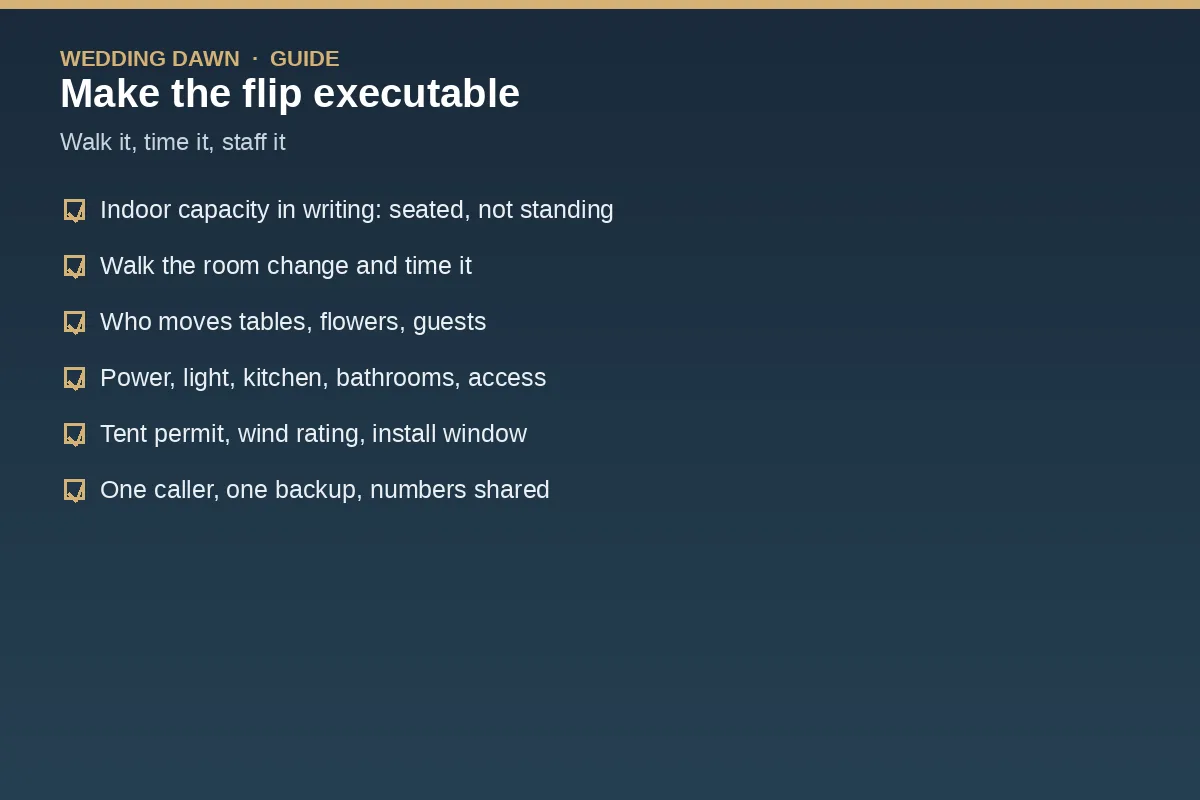
Ask for the indoor capacity in writing, including seated guests at tables, not the standing reception maximum. Confirm that the indoor option carries the same license, the same curfew and the same parking. Some venues will cheerfully offer a rain room that seats sixty of your hundred and twenty guests.
Walk the flip in person with the venue's operations manager, and time it. A room change with a crew that has done it before takes sixty to ninety minutes. Without a crew it takes three hours, and your ceremony starts late. Decide in advance who moves tables, who moves flowers, and who keeps guests out of the way while it happens.
Check the unglamorous details: power for the band, lighting for the room, step-free access for grandparents, bathroom capacity, coat storage, and whether the caterer can plate from a different kitchen. A plan B that cannot feed people is not a plan.
Tents, heaters, and what they really cost
If the backup is a tent, size it at twelve to fifteen square feet per seated guest, then add the buffet, bar, dance floor and band. A 20-by-40-foot frame tent holds roughly sixty guests at rounds; a 40-by-60 holds about a hundred and fifty. Sidewalls, flooring, lighting and heating are separate line items, and each has its own lead time.
Ask about permits, fire code, staking versus ballasting, and the wind rating. A tent that is not rated for the wind on your site is a liability, not a backup. Confirm the installation window: many companies install the day before and will not return at six in the morning because you changed your mind. Get the cancellation terms in writing, including what you lose if you release the tent forty-eight hours out.
Heaters and fans are cheaper than the tent but they need power. Ask the venue for the outdoor amperage before you rent anything that plugs in, and ask who is responsible if the generator fails.
Heat is more dangerous than rain
Guests forgive a wet ceremony. They do not forgive heat exhaustion. Above a heat index of 95°F, shorten the ceremony, push the start later, add shade and water stations, and tell people what to wear. Above 103°F, move indoors even if the sky is clear.
Put one named person in charge of water and shade, and give vendors explicit permission to take breaks. Photographers and officiants in dark clothing overheat first. Have a cool room, ice, and a written plan for anyone who feels faint, and know where the nearest urgent care is before you need it.
Wind, smoke, and the risks nobody puts on the mood board
Wind takes down arches, candles, place cards and light furniture. Use weighted bases where the ground is hard, skip open flame, and keep a box of weights and clamps behind the bar. For wildfire smoke, follow the Air Quality Index: above 150, move vulnerable guests indoors and shorten outdoor time; above 200, move the event.
Check whether the site allows open flame at all. A candle plan that violates the fire permit is not romantic; it is a shutdown waiting for a match.
Write a decision timeline
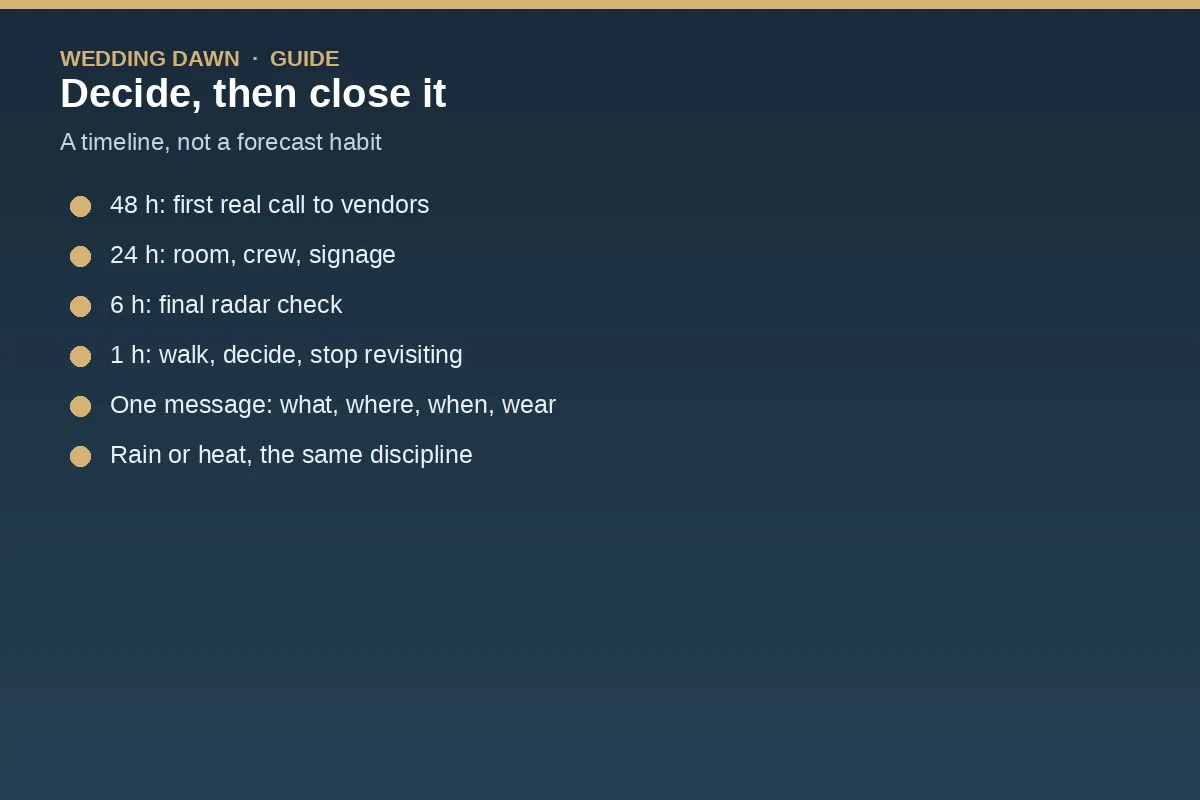
Seven days out, confirm the indoor option and the tent hold. Seventy-two hours out, check the forecast twice a day. At forty-eight hours, the caller makes the first real decision and tells the vendors. At twenty-four hours, confirm the room, the crew call time and the new signage. At six hours, a final radar check. One hour before, the caller walks the site, makes the last call, and then stops revisiting it.
Put those times in the vendor schedule and send it to everyone, including the photographer and the band. A decision that is not on a schedule is only a hope.
Tell guests without creating a second event
Use one channel as the source of truth: the wedding website, plus a single group message that points to it. Do not host a debate in the comments. Send the first message only when the decision is real: what changed, where to go, when, what to wear, and whom to ask.
Include a wet-weather dress code in the same message: flats, a layer, an umbrella if the walk is outdoors. If shuttles or parking change, say so in the same place. Ask the wedding party to repeat the message, not to interpret it.
Put a weather clause in the contracts
Read what your contracts actually say about weather. Force majeure usually covers impossibility, not inconvenience; an ordinary rainy Saturday is rarely impossible. Ask every vendor for reschedule and cancellation terms in writing, including fees, deadlines, and whether a deposit can move to a second date.
Consider event cancellation insurance if the budget allows, and read the exclusions carefully: many policies exclude rain unless a named storm or a government order closes the site. Confirm the tent company's insurance and the venue's liability coverage before the week begins.
The day-of call
At the deadline, the caller checks the radar, walks the site, and decides. Then the decision is closed. Reopening it every hour is how couples end up with half a ceremony in the rain and half in a ballroom. Trust the thresholds you set while you were calm; that was the entire point of setting them early.
Step by step
Write the thresholds
Rain probability 60% for two hours, wind over 20 mph, heat index over 95°F, lightning within 10 miles. Put the numbers in the vendor schedule.
Name one caller and a backup
Someone outside the wedding party, with a mobile number every vendor has. The couple does not arbitrate on the day.
Get the indoor room in writing
Seated capacity, curfew, kitchen, power, bathrooms, access. Walk the flip with the operations manager and time it.
Price the tent and the flip crew
12–15 sq ft per seated guest, plus sidewalls, floor, lights, heat, permit and install window. Read the cancellation terms.
Send one message, once
Website plus a single group message: what changed, where, when, what to wear, whom to ask. No debate in the comments.
Quick checklist
- Thresholds written down: rain, wind, heat index, lightning distance.
- One caller and one backup named, with numbers in the vendor schedule.
- Indoor capacity confirmed in writing, seated not standing.
- Room flip walked and timed with the venue's operations manager.
- Tent sized per guest, with sidewalls, floor, lighting and heat quoted separately.
- Permit, fire code and wind rating checked before paying a deposit.
- Installation and cancellation deadlines in writing.
- Outdoor power amperage confirmed for band, lights and heaters.
- Heat plan: shade, water, cool room, nearest urgent care.
- Air Quality Index threshold agreed for smoke.
- Decision timeline sent to every vendor, including photographer and band.
- One guest message drafted, with wet-weather dress code and transport changes.
FAQ
When should we make the weather call?
Make the first real call at 48 hours, using the thresholds you set in advance, and confirm the room and crew at 24 hours. Check the radar again six hours out, and make the final walk one hour before. The point of the 48-hour call is to give vendors and guests time to act, not to predict the sky perfectly.
Does wedding insurance cover rain?
Usually not by itself. Many event cancellation policies exclude ordinary bad weather and pay only for a named storm, a government closure or an inaccessible venue. Read the exclusions before you buy, and treat insurance as protection against catastrophe, not as a substitute for a tent or an indoor room.
How big a tent do we need?
Plan on 12 to 15 square feet per seated guest, then add the buffet, bar, dance floor and band. A 20-by-40-foot frame tent seats about sixty at rounds; 40-by-60 seats about a hundred and fifty. Sidewalls, flooring, lighting and heating are extra, and each has a lead time.
What if the forecast is only hot, not rainy?
Heat needs its own plan. Above a heat index of 95°F, shorten the ceremony, move the start later, add shade and water, and tell guests what to wear. Above 103°F, move indoors. Put one person in charge of water and shade and give vendors permission to take breaks.
Should we warn guests about the weather in advance?
Tell them the plan, not the forecast. Give them the wet-weather dress code, the indoor location and the one channel where updates will appear. Do not ask them to decide anything or to watch the radar themselves; that is the caller's job.
Sources
- National Weather Service — heat index and wind safety Heat index thresholds and outdoor event guidance; checked 2026-11.
- AirNow — Air Quality Index AQI categories used for wildfire smoke decisions; checked 2026-11.
- FTC Consumer Advice — shopping for a wedding or event Deposits, cancellation terms and event contracts; checked 2026-11.