Wedding Transport Guide: Shuttles & Cars
Transportation is the part of a wedding that fails in public. A late shuttle leaves forty guests standing in a hotel lobby; a getaway car parked behind a locked gate turns a romantic exit into a fifteen-minute wait. The fix is not a bigger vehicle budget. It is mapping every trip, deciding who is responsible for each one, and writing the timing down where the people who need it can see it. This guide covers the decisions in the order they matter: the trips, the shuttles, the couple's car, the cost, the contract, and the day-of timeline.
Map every trip before you shop for vehicles
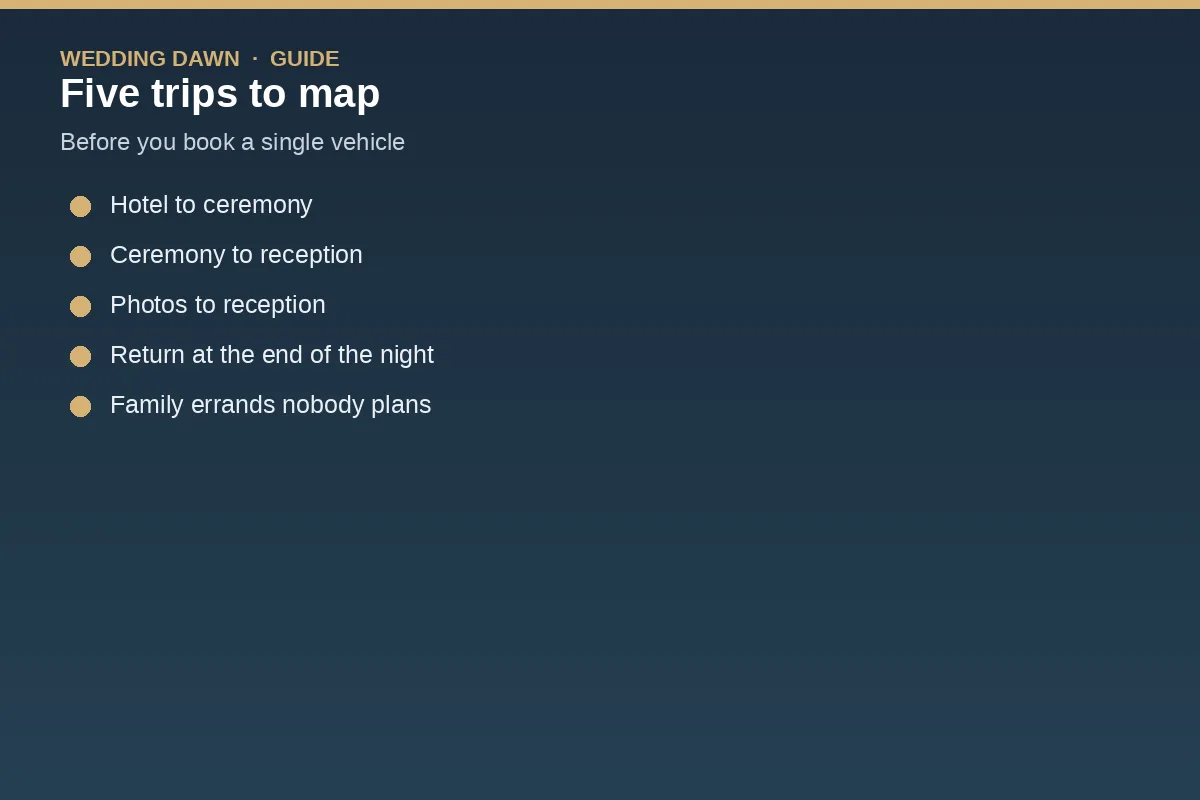
Start with a list of movements rather than a list of vehicles. Most weddings need five: guests from hotels to the ceremony, guests from the ceremony to the reception if the venues differ, the couple and wedding party between photo locations and the reception, the return trip at the end of the night, and family errands that nobody plans for. For each trip, write the departure point, arrival point, number of people, time they must arrive, and who holds the final decision if a vehicle is late. That last column is the one couples skip and later regret. A shuttle coordinator with a phone and authority solves most problems before they reach you.
- The arrival target is thirty minutes before the ceremony, not the departure time.
- Count the wedding party separately; they often travel earlier and with more bags.
- Photos between ceremony and reception add a stop that needs its own vehicle and buffer.
- Plan the return trip before the outbound one; guests leave in waves, not at one time.
Guest shuttles: size by seats, not by guest count
The common mistake is ordering one bus for the guest count. Guests do not travel in one wave. The hotel block, the early arrivers, the family that decides to drive, and the friends who stay for the last song all behave differently. Work from the number of seats you need at the busiest moment, then add a fifteen to twenty percent buffer for the people who decide at breakfast to take the bus. For a wedding of 120 with half staying in the block, two forty-seat coaches are usually more useful than one seventy-seat coach, because the second bus can run a later departure and a return loop. Ask the operator how many trips are included; a shuttle that makes one outbound and one return run is not the same product as one that loops every thirty minutes.
- Seat count at peak, plus a 15-20 percent buffer.
- Number of loops included, and the cost of an extra loop.
- Last departure time and the policy if guests miss it.
- Accessibility: at least one vehicle that takes a wheelchair without dismantling it.
The getaway car is a timetable problem
The couple's car looks like a styling decision and behaves like a scheduling one. Decide first whether you are leaving from the reception, from a photo stop, or from the ceremony, because each changes the vehicle and the driver. A vintage car with no air conditioning is charming for a ten-minute ride and miserable for an hour in August. Confirm whether the company provides a driver, whether the driver waits on site, and how many hours are included. Decoration matters less than access: check gate codes, loading zones, and whether the car can reach the door rather than the parking lot. If you want a sparkler exit or a confetti line, tell the driver and the venue in advance; some insurers prohibit open flames near vehicles, and some venues prohibit both. Ask the operator to send a photo of the actual vehicle and its registration plate a week before, so the day-of team knows exactly what to look for.
What transportation really costs
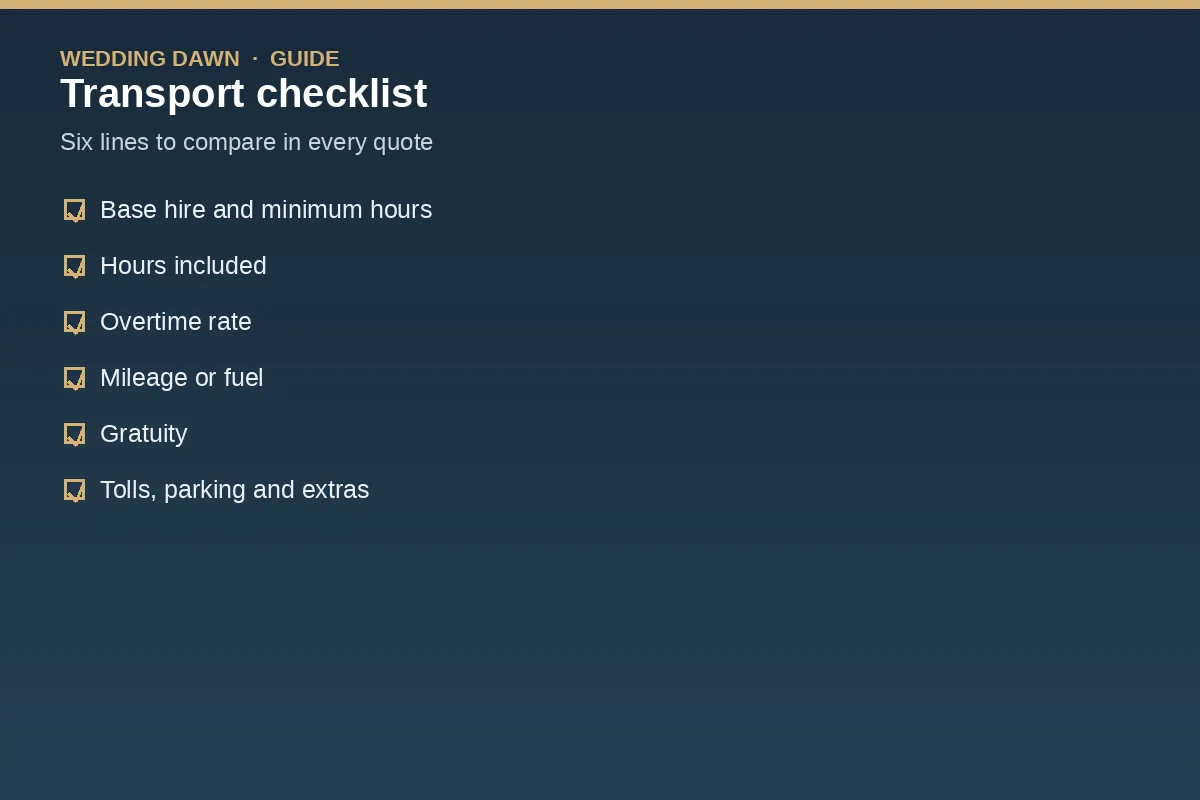
Quotes are rarely comparable because operators bundle different things. A limousine quote may include a three-hour minimum, fuel, and gratuity but exclude a holiday surcharge and the extra hour you will inevitably need. A coach quote may include the driver but charge per mile beyond a radius. Ask every operator for the same breakdown: base hire, hours included, overtime rate, mileage or fuel, driver gratuity, tolls and parking, holiday or weekend surcharge, and cancellation terms. Then compare the total for your actual timeline, including the buffer. As a market guide, a sedan or SUV for the couple commonly sits in the low hundreds to several hundred dollars for a few hours, a vintage or luxury car can run higher, and guest coaches are usually priced per vehicle per block of hours rather than per person. Treat these as orders of magnitude, not quotes; local markets vary widely.
- Base hire and the minimum hours billed.
- Overtime rate per hour, and how it is rounded.
- Gratuity: included or expected in cash?
- Tolls, parking, and any venue access fee.
- Cancellation and postponement terms.
Contracts, drivers, and the fine print
Transportation contracts are short and deceptively simple. Check the legal operator name and the vehicle class you are paying for; a fourteen-passenger stretch SUV is often a truck chassis, and luggage space disappears when fourteen people sit down. Confirm the insurance limits and ask for a certificate of insurance naming the venue where required. Ask who the actual driver will be and whether substitutions are allowed. Read the late-arrival clause: most operators promise a vehicle, not a time, and traffic is usually excluded. Ask what happens if the vehicle breaks down, how a replacement is dispatched, and how long that takes. For coaches, confirm that the operator holds the correct passenger-carrier authority and that driver hours comply with rest rules. If a quote is dramatically cheaper than every other, the missing line is usually insurance, a licensed driver, or the return trip. Keep the signed contract and the insurance certificate in the same folder as the timeline, and give the coordinator a paper copy; phone screens fail at the worst moment.
- Legal company name and operating authority.
- Vehicle year, class, and real seat count with luggage.
- Certificate of insurance and additional-insured status.
- Breakdown and replacement policy in writing.
- Driver contact number released 24 hours before.
Build a timeline that survives traffic
Write the transportation plan as a table with clock times, not as a paragraph. Give every vehicle a call time, a departure time, and an arrival target, and give the coordinator the driver's mobile number rather than the office number. Add a fifteen-minute buffer to every leg that crosses a city, and a thirty-minute buffer for anything on a highway during rush hour. Share the table with the venue, the photographer, and the person holding the rings. On the day, the coordinator should confirm each vehicle fifteen minutes before its call time; a five-minute delay caught early is a text message, a twenty-minute delay caught at the door is a crisis. Print two copies and keep one in the couple's bag.
The test of a transportation plan is boring: nobody notices it. If guests arrive with time to find a seat, if the couple leaves while the room is still full, and if the last bus is not a negotiation, the plan worked. Build it early, put one person in charge, and keep the buffer.
Step by step
List every trip and its owner
Write origin, destination, headcount, arrival time, and the one person who decides if a vehicle is late.
Size shuttles at peak, then add buffer
Count seats at the busiest moment and add 15-20 percent; ask how many loops the quote includes.
Lock the couple's car access
Confirm driver, waiting time, gate codes, and whether the car can reach the door rather than the car park.
Compare quotes on six identical lines
Base hire, included hours, overtime, mileage, gratuity, and extras; ignore the headline price.
Publish a clock-time table
Share it with venue, photographer, and coordinator; confirm each vehicle 15 minutes before call time.
Quick checklist
- Every trip has an owner and a phone number.
- Shuttle seats cover the peak plus a buffer.
- Last departure time is written and shared with guests.
- The couple's car can physically reach the exit door.
- Insurance certificate and replacement policy are on file.
- Driver mobile numbers are confirmed 24 hours before.
FAQ
How far in advance should we book wedding transportation?
Book shuttles and specialty cars as soon as the date and venue are fixed, especially for summer weekends and graduation season. Two to four months ahead is a practical target for most markets; popular vintage cars and large coaches go earlier.
Are guest shuttles worth the cost?
They are worth it when parking is limited, the hotel is more than fifteen minutes away, or guests will drink. They are usually unnecessary when everyone lives locally and the venue has ample parking.
Who tips the driver?
Clarify this in the contract. If gratuity is not included, budget a cash tip and give it to the coordinator or the lead driver at the end of the service, not to each driver separately.
What if guests miss the last shuttle?
Publish the last departure time twice and have the coordinator do a final headcount ten minutes before. Keep a local taxi number and a small contingency fund rather than asking the driver to wait for free.
Do we need permits for a photo stop or vintage car?
Some parks, beaches, and historic districts require filming or commercial photography permits, and some restrict vehicles on pedestrian paths. Ask the site and the car operator before the day, not during the shoot.
Sources
- FMCSA - Passenger Carrier Safety Federal rules for buses and passenger carriers; used for operating authority and driver-hours checks, reviewed 2026-11.
- NHTSA - Seat Belts Seat-belt guidance for guest shuttles and private vehicles, reviewed 2026-11.
- U.S. Department of Transportation Consumer complaint routes for interstate passenger carriers, reviewed 2026-11.