How to Give a Wedding Toast People Remember
A wedding toast fails for a predictable reason: it tries to say everything. The speaker wants to honor the friendship, thank the parents, mention the couple's first date, include an inside joke and land a compliment, all in four minutes. The result is a list, and lists are not memorable. Stories are.
The toast that people quote the next morning has a simple shape: one story, one turn, one blessing. The story makes the room lean in. The turn tells them why it matters. The blessing sends the couple into the next part of the night. Everything else is optional, and most of it should be cut.
Choose one story, not a summary of the friendship
Pick a single moment that shows who the couple is when nobody is watching. Not the proposal, not the wedding day, not the time you all went to Mexico. A small scene: the first time one of them cooked for the other and burned it, the night they drove four hours to pick up a rescue dog, the afternoon they painted a flat together and argued about the color of a wall.
The story should be specific enough to be true and small enough to be told in ninety seconds. If you find yourself explaining three years of context before the story starts, you have chosen the wrong story. Choose the one that needs no context because the action carries it.
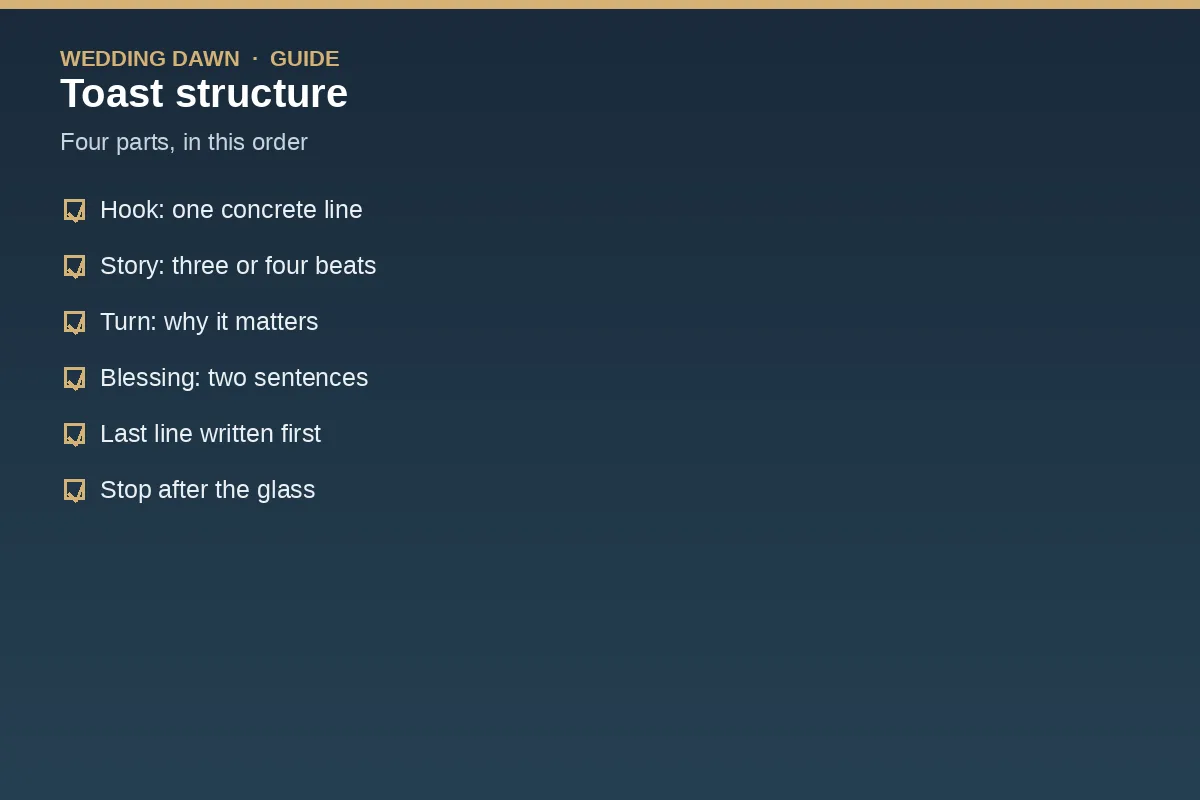
Structure: hook, story, turn, blessing
Open with a line that makes people look up. Not a joke about the microphone, not a weather report. A short, concrete sentence: I met Anna in a hospital waiting room, and she was the only person laughing. Then tell the story in three or four beats, with one detail per beat, not ten.
The turn is one sentence that connects the story to the marriage: that is when I understood that she would show up for the people she loves, every time. The blessing is two sentences, addressed to the couple, not to the room: I hope you keep showing up for each other like that. To Anna and Ben.
Write the last line first. If you know the exact sentence you will end on, the middle of the speech will find its shape. If you do not know the last line, the speech will not end; it will just slow down and stop.
The first fifteen seconds and the last ten
The first fifteen seconds decide whether the room listens. Say your name, say who you are to the couple, and start the story. Do not thank the venue, do not list the bridal party, do not apologize for being nervous. Nervousness is normal; announcing it gives the room permission to stop paying attention.
The last ten seconds decide what people remember. Look at the couple, not at your notes. Say the blessing slowly, raise your glass, and stop talking. Do not add a second ending. Do not say that is it, I think. The silence after the glass is part of the toast.
Write for the room, not only for the couple
Inside jokes are the most common failure of an otherwise good toast. The couple laughs, the room waits, and the speaker explains the joke, which kills it. A useful rule: if fewer than half the room can understand a reference without explanation, cut it. If it is essential, give it one sentence of context and move on.
The room includes grandparents, children, coworkers and people who have never met the couple. A toast that makes them feel included is warmer than one that makes them feel like spectators. The test is not whether the couple loves it; it is whether the room can follow it.
Length and pacing: two to three minutes
Two to three minutes is the reliable range; 350 to 450 words at a relaxed pace. Four minutes is long. Five is a speech, and a wedding is not a conference. If you have more material, cut it; the best compliment a toast can receive is that people wanted more.
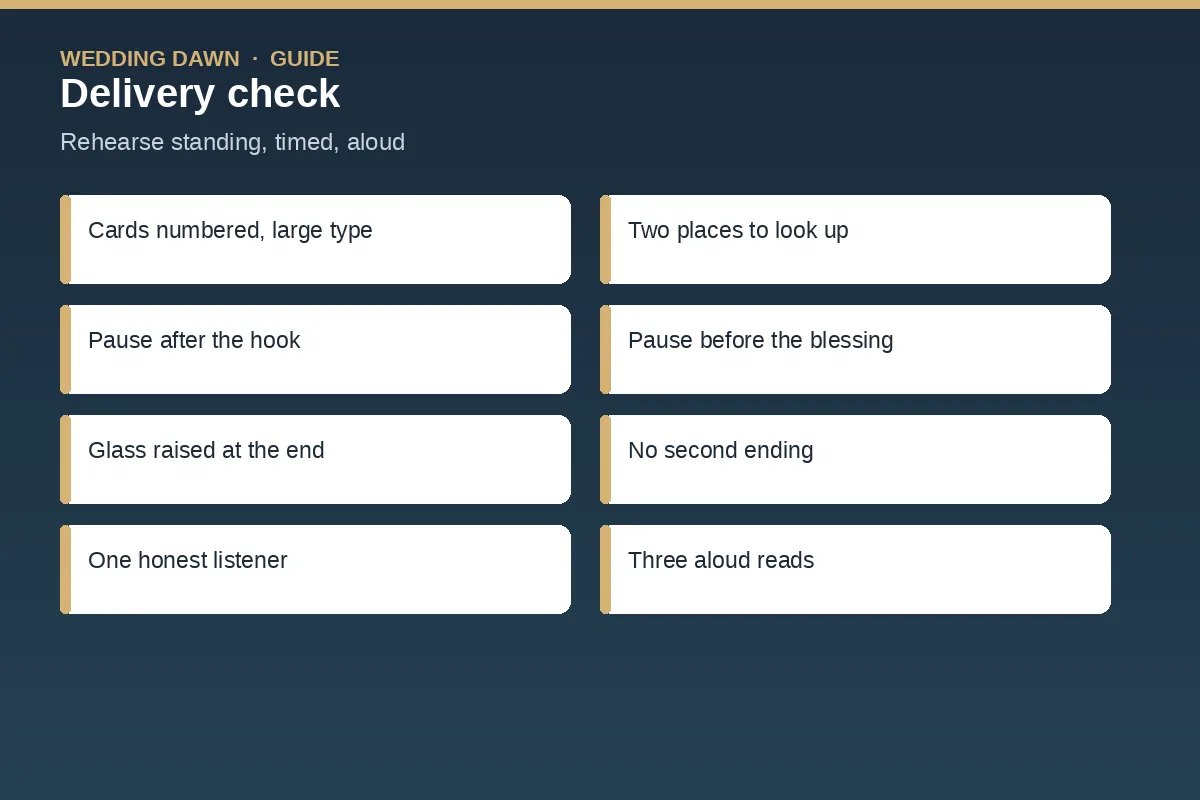
Pacing matters more than length. Short sentences. One pause after the hook. One pause before the blessing. If you read from a page without looking up, the room will read the page with you and stop listening. Mark two places in your notes where you will look at the couple, and keep those pauses even if you feel silly.
What to include, what to leave out
Include: one specific story, one quality of the couple, one acknowledgement of the families if it fits, and one blessing. Leave out: exes, drinking stories that end with someone in trouble, jokes about the couple's flaws that only you find funny, and anything you would not say in front of the couple's parents.
The roast is a genre, not a default. A light tease is fine if the couple teases each other the same way; a story that humiliates one of them will be remembered for the wrong reason. If you are unsure, cut it. The bar for a toast is not how funny it was; it is whether the couple can enjoy it in ten years.
Delivery: cards, pace, microphone
Use small cards, not folded A4. Number them. Write in large type, one beat per card, and hold them low so they do not cover your face. If there is a microphone, stand close enough that you do not have to shout, and test it before the room fills. If there is no microphone, speak to the back row, not to the couple.
Hold the glass at the end, not during. A glass in one hand and cards in the other leaves no hand for the microphone. Practice the last line with the glass raised, so the gesture is automatic when you are nervous.
Nerves, tears, and the pause that saves you
Nerves are physical: shallow breathing, fast speech, shaky hands. Before you stand, breathe out longer than you breathe in, three times. During the toast, if your voice shakes, stop for two seconds. The room will wait. The pause reads as emotion, not as failure.
If you cry, keep going or take a sip of water. Do not apologize. The couple will remember that you cared enough to be moved; they will not remember the sentence you lost. If you blank, look at your last card, say the blessing, and sit down. The ending is the part that matters.
Two people, one toast
If two people are speaking, decide who opens, who tells the story and who gives the blessing. Do not alternate line by line; it reads as a scripted bit and halves the emotional momentum. A clean division, with one handoff, is easier to follow and easier to rehearse.
The handoff should be a sentence, not a shuffle: I will let Maya tell you how they met. Then step back, not sideways into the microphone. The second speaker should not repeat the first speaker's joke or thank the same people. One greeting, one story, one blessing.
Rehearse out loud, on your feet
Read the toast aloud three times, standing up, with a timer. The first read finds the sentences that do not work. The second finds the places you run out of breath. The third finds the ending. Do not rehearse silently; silent rehearsal teaches you the words but not the pace.
Rehearse in front of one person who will tell you the truth. Ask three questions: where did you stop listening, which line did you not understand, and did the ending land? Fix those three things, not everything. A toast that has been heard once is twice as good as one that has only been read.
If you are the couple: who to ask and what to say
Ask people who know you as a couple, not the most confident speaker in the room. Give them a length, a tone and a boundary: two to three minutes, warm not roast, no exes, nothing about the 2019 incident. Specific boundaries produce better speeches than please keep it short.
Ask early enough that they can write without panic, usually six to eight weeks out. Send them three photographs and two facts they might not know. Do not ask them to read a draft; ask them to rehearse out loud once. And when the toast happens, put your fork down and look at them. That is the thank-you.
A fill-in template
My name is ___, and I am ___'s ___. I met them ___. One afternoon, ___. What I noticed was ___. That is the person who is marrying ___ today. So here is what I hope for you: ___. To __ and ___.
The template is not a formula for a great speech; it is a guard against a shapeless one. Fill it, read it aloud, then cut one third. The third you cut is usually the context, the second joke and the explanation of the first joke. What remains is the toast.
A toast is not a performance of how much you love the couple. It is a small, specific gift: one story they will be glad you told, one sentence that names what they have, and one blessing they can carry into the marriage. Say it, raise the glass, and stop.
Step by step
Choose one small story
A single moment that shows who they are when nobody is watching. No proposal, no travelogue, no three years of context.
Write the last line first
A two-sentence blessing addressed to the couple. Then build the story backward from it.
Draft to 350–450 words
Hook, three or four story beats, one turn, one blessing. Cut every inside joke the room cannot follow.
Rehearse standing up, timed
Three aloud reads with a timer, then once in front of one honest listener. Fix the three things they name.
Deliver and stop
Name, story, blessing, glass raised. Pause before the last line, look at the couple, and do not add a second ending.
Quick checklist
- One specific story, ninety seconds or less.
- No more than one sentence of context before it.
- Last line written before the middle.
- Draft between 350 and 450 words.
- Every reference understandable to half the room.
- No exes, no humiliation, no drinking story with a victim.
- Opening names you and your relationship to the couple.
- Two marked places to look up from the cards.
- Rehearsed aloud three times, standing, timed.
- One honest listener asked: where did you stop listening?
- Glass raised only at the end.
- No second ending after the blessing.
FAQ
How long should a wedding toast be?
Two to three minutes, roughly 350 to 450 words at a relaxed pace. Four minutes feels long, five is a speech. If you have more material, cut it; the best toast leaves the room wanting a little more, not checking the time.
What if I am not good at public speaking?
Use one story and a written last line. Rehearse standing up three times and once in front of one person. Keep the cards low, look up at two marked points, and pause before the blessing. Competence matters less than specificity and warmth.
Should I tell jokes?
A light tease is fine if the couple teases each other the same way. Avoid jokes that humiliate, reveal an ex, or require explanation. The test is whether the couple can enjoy the story in ten years, not whether the room laughs in the moment.
What if I cry or blank?
Stop for two seconds, breathe, and take a sip of water. Do not apologize. If you blank, look at your last card, say the blessing and sit down. The ending is what people remember, and a pause reads as emotion rather than failure.
Can two people give one toast?
Yes, with a clean division: one opens, one tells the story, one gives the blessing, with a single spoken handoff. Do not alternate line by line. Rehearse the handoff so it feels like one toast rather than two separate speeches.
Sources
- Toastmasters International — speech structure and delivery Opening, pacing and pause guidance; checked 2026-11.
- Emily Post Institute — wedding toasts Role, tone and etiquette of wedding toasts; checked 2026-11.
- FTC Consumer Advice — shopping for a wedding or event Contract and vendor context for paid speech coaches; checked 2026-11.