Wedding Insurance: What It Covers
Wedding insurance is the one purchase you make hoping it stays in a drawer. It produces nothing you can photograph, and if it does its job, something has already gone wrong: a venue closes, a supplier vanishes with a deposit, or a storm flattens the marquee. That is exactly why it gets postponed until the week before the wedding, when most new cancellation cover has already expired. The practical way to decide is to stop thinking about the average wedding and start thinking about the three losses you could not absorb without changing your plans.
This guide covers what standard policies actually include, where the exclusions hide, how much cover is sensible for your guest count, and how the purchase fits with contracts you have already signed. It assumes wedding insurance is sold as a standalone policy or as an endorsement to home or event cover, which is common in the United States, the United Kingdom, Canada, and Australia. The wording differs between insurers; the questions do not. Read the sections in the order you would need them on a bad day: cancellation first, then supplier failure, then liability.
Start with the losses you cannot absorb
Write down five events that would force you to cancel, move, or rebuild the day: the venue becoming unavailable, a key supplier failing, severe weather, serious illness of someone central, and injury or damage involving a guest. Then mark which ones you could absorb with money you already have. Losing a two-thousand-dollar deposit is painful but survivable. Losing the venue six weeks out, with deposits paid to eight suppliers and guests already booking flights, is not. Insurance earns its premium on the second kind of event. That is also why it can feel expensive in a calm year: you are buying protection against low-probability, high-consequence failures, not against ordinary hiccups.
- Count only non-refundable money when you set the sum insured.
- Treat cancellation risk and liability risk as separate questions; they usually sit in different sections.
- Ask whether each supplier's own insurance already covers their failure, and how you would claim on it.
What a standard policy covers
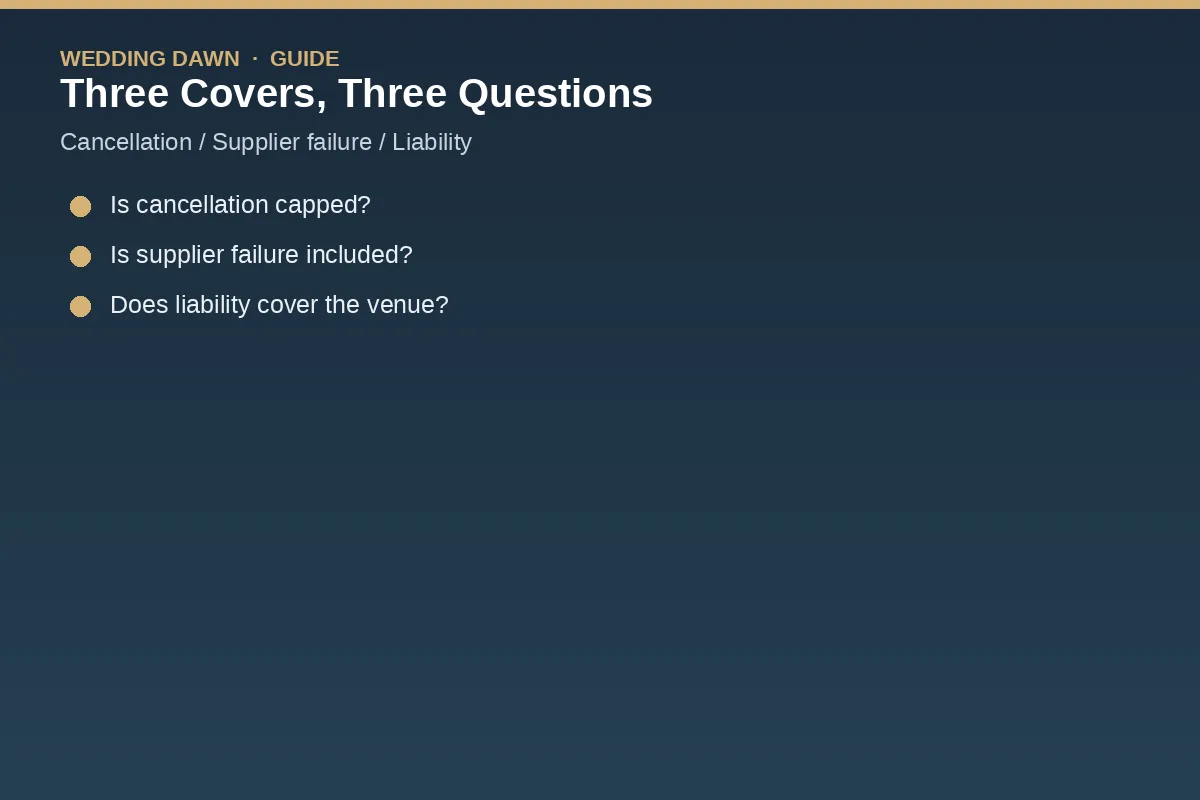
Most wedding policies combine three covers. Cancellation or postponement reimburses deposits and contracted costs when the event cannot go ahead for a covered reason, such as venue failure, serious illness, bereavement, transport disruption, or extreme weather. Supplier failure covers a vendor who becomes insolvent or simply does not turn up. Liability covers injury to a guest or damage to the venue, and is the section couples overlook because it feels abstract until a guest falls through a deck. Many policies add rings, gifts, attire, and photography, usually with per-item limits and a requirement to store valuables securely.
- Check the cancellation limit as a share of total spend, not just the headline sum.
- Confirm whether supplier failure is included or sold as an optional extension.
- Ask whether liability responds at both the ceremony and the reception venue.
Liability is the section you cannot skip
Liability cover is the least romantic and most important part of the policy. A guest trips on a cable, a child pulls a tablecloth and a heater falls, a marquee stake cuts a sprinkler line: the venue's insurer may pay first, then pursue you. Standard event liability responds to bodily injury and property damage for which you are legally responsible, up to the limit, after the excess. Check that it applies at the ceremony, the reception, and any pre-wedding dinner, and whether it covers damage caused by your suppliers. If the venue demands a certificate naming it as additional insured, confirm the insurer will issue one before you pay the deposit.
- Ask for the limit per occurrence, not just per policy.
- Confirm the venue can be named as an additional insured.
- Check whether damage caused by your suppliers is included.
Where the exclusions hide
The expensive surprises are rarely in the summary. They live in definitions and conditions: a named-storm exclusion that switches on when a weather service issues a warning; an illness clause that requires a doctor's note and excludes pre-existing conditions; a failure-to-supply clause that covers insolvency but not a supplier who stops answering calls; and a change-of-mind exclusion, which is standard and means cold feet is not insured. Read the policy against your own risk list rather than the brochure. If the venue sits on a floodplain, ask how flood is defined. If the wedding is outdoors, ask what wind speed triggers a claim and who must order the cancellation.
- Change of mind or a relationship breakdown, unless a specific extension is bought.
- Known events at the time of purchase, including a storm already forecast.
- Deposits paid in cash without a written contract or receipt.
- Venue repairs or wear and tear unrelated to your event.
- Losses caused by a supplier you failed to check for insurance or licensing.
How much cover, and what it costs
Set the cancellation sum insured at your total non-refundable spend, including venue, catering, travel, and vendor deposits, then read the per-category sub-limits. A policy that promises fifty thousand but caps supplier failure at two thousand will not solve the problem you bought it for. Premiums are usually a small percentage of the insured total, and the price moves with guest count, venue type, alcohol, pyrotechnics, and whether the event is indoors. The cheapest quote is often cheap because cancellation is capped, liability is excluded, or the excess is high. Compare three quotes on identical limits and identical deductibles before deciding.
Read the vendor contract and the policy together
Insurance cannot fix a contract that never required the supplier to carry their own cover or to refund deposits on cancellation. Before you buy, collect the cancellation and force majeure clauses from the venue and each major supplier, and check that your policy does not treat their obligations as your first line of recovery. Where a supplier does hold insurance, ask for a certificate and confirm it is current. Where they do not, decide whether you are willing to carry that risk yourself. This is also the moment to confirm whether deposits are held in trust or paid directly, because recovery after insolvency depends on it.
If you have to claim
Claims are won or lost on documentation. Keep contracts, receipts, bank records, correspondence, and a dated timeline in one folder from the day you book. Notify the insurer as soon as a covered event looks likely, not after you have canceled; many policies require prior approval for extra costs. Photograph damage before anything is moved. Request the venue's incident report for a liability claim. Do not accept a supplier's private settlement before checking whether it affects your right to claim.
Keep the claim reference on every message, and ask for the complaint route if a decision seems inconsistent with the wording.
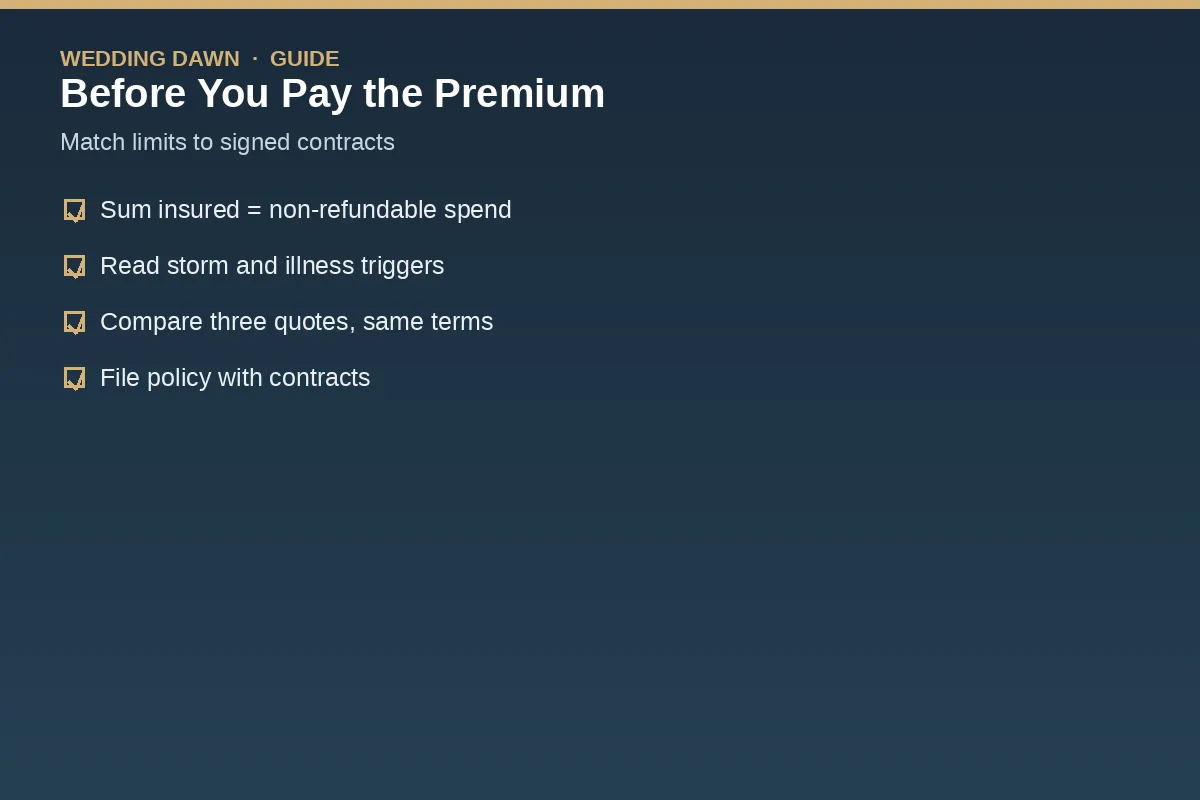
- Sum insured equals non-refundable spend, not the whole wedding budget.
- Supplier failure and severe weather are covered in writing.
- Liability includes guest injury and venue damage.
- The excess is affordable and you know how it is applied.
- Every major contract and receipt is in one folder.
- The insurer's emergency number is saved in two phones.
Review the policy once a year
Policies are written for the wedding you described, so re-read the wording whenever the date, venue, guest count or supplier list changes. Put a reminder thirty days before the final payment and check three things: the sum insured still matches your non-refundable spend, every named supplier appears in the schedule, and the claims phone number is saved offline. A ten-minute review now is cheaper than discovering a gap in the week you need to claim.
Step by step
List the five losses you cannot absorb
Venue failure, supplier failure, weather, illness, and guest injury. Write the dollar exposure beside each one.
Total your non-refundable spend
Add venue, catering, travel, attire, and every deposit. This number, not the wedding budget, sets the sum insured.
Read exclusions against your risk list
Check storm triggers, illness definitions, supplier failure, and change of mind. Ask the insurer to confirm anything ambiguous in writing.
Compare three quotes on identical terms
Same limits, same excess, same extensions. Ignore the headline premium until the limits match.
File the policy with your contracts
Save the policy, certificate, and emergency number where the person handling the wedding can find them on the day.
Quick checklist
- Sum insured matches non-refundable spend.
- Supplier failure is covered, not assumed.
- Severe weather trigger is defined in writing.
- Liability covers guest injury and venue damage.
- Excess and sub-limits are understood.
- Contracts and receipts are stored in one folder.
FAQ
Is wedding insurance worth it for a small wedding?
It is most valuable when non-refundable deposits are large relative to your savings, or when the venue or suppliers are far from home. For a small backyard wedding with little prepaid cost, liability cover through an existing home policy may be enough.
When should we buy wedding insurance?
Buy as soon as you commit to a venue and start paying deposits. Cancellation cover usually starts at purchase, and policies bought in the final weeks often exclude cancellations that are already foreseeable.
Does wedding insurance cover rain?
Only if the policy defines weather as a covered cause and the trigger is met, for example an official warning or a specified rainfall threshold. Ordinary rain that makes the day less pleasant is not a claim; a named storm that forces cancellation may be.
What happens if a supplier goes out of business?
Cover depends on whether supplier failure is included. You will normally need the contract, proof of payment, and evidence that the supplier has ceased trading. Check whether the policy pays to rebook or only refunds the lost deposit.
Does it cover the honeymoon or the rings?
Some policies extend to rings, gifts, and attire, and a few cover travel disruption. Honeymoon travel is usually covered by separate travel insurance, so check both policies to avoid paying twice for the same risk.
Sources
- NAIC - Consumer Insurance Resources State insurance regulators' consumer guidance on reading policies and filing complaints, reviewed 2026-11.
- FTC - Consumer Advice Consumer protection guidance on contracts, cancellations, and refunds, reviewed 2026-11.
- Insurance Information Institute Background on event and liability coverage terms; used for definitions, reviewed 2026-11.