Wedding Guest List Etiquette Without the Guilt
Guest list conversations go wrong because two different documents are being written at the same time. One is a budget: every name costs a meal, a chair, a favor and a slice of attention. The other is a boundary: who counts as close, who is invited out of obligation, and who will be hurt if they are not. Couples who argue about names are usually arguing about which document they are editing.
Separate them. Decide the number first, write the rule second, and handle individual exceptions last. That order does not make the conversation painless, but it makes it finite, and a finite conversation is the only kind that ends before the wedding.
Set the number before the names
Start with capacity and cost, not with people. The venue gives a seated maximum; the caterer gives a per-head price; the stationer gives a per-invitation cost. Multiply, then add a 10 to 15 percent buffer for plus-ones, late additions and the cousin who rsvps twice. The number you can afford is the number you have, and every name after that is a trade against something else.
Write the number down and put it where both families can see it. A number in a shared document is harder to negotiate than a number remembered differently by four people. If the budget and the dream list do not meet, the gap has to be closed by a rule, not by hoping some guests decline.
Build in tiers, not one flat list
Divide the list into A, B and C. A is people without whom the wedding would feel wrong; B is people you want there if space allows; C is people invited out of obligation or politics. Most couples find that A is smaller than they expected and C is larger. That is useful information, not a verdict on your friendships.
The tiers also decide the invitations. Send A first, with the earliest rsvp date. Send B only when A declines free enough seats. C is a deliberate decision, not a default; if the list is already full, C stays off. Never tell anyone which tier they are in; the tier is an internal planning tool, not a social label.
Plus-ones: a rule, not a case-by-case negotiation
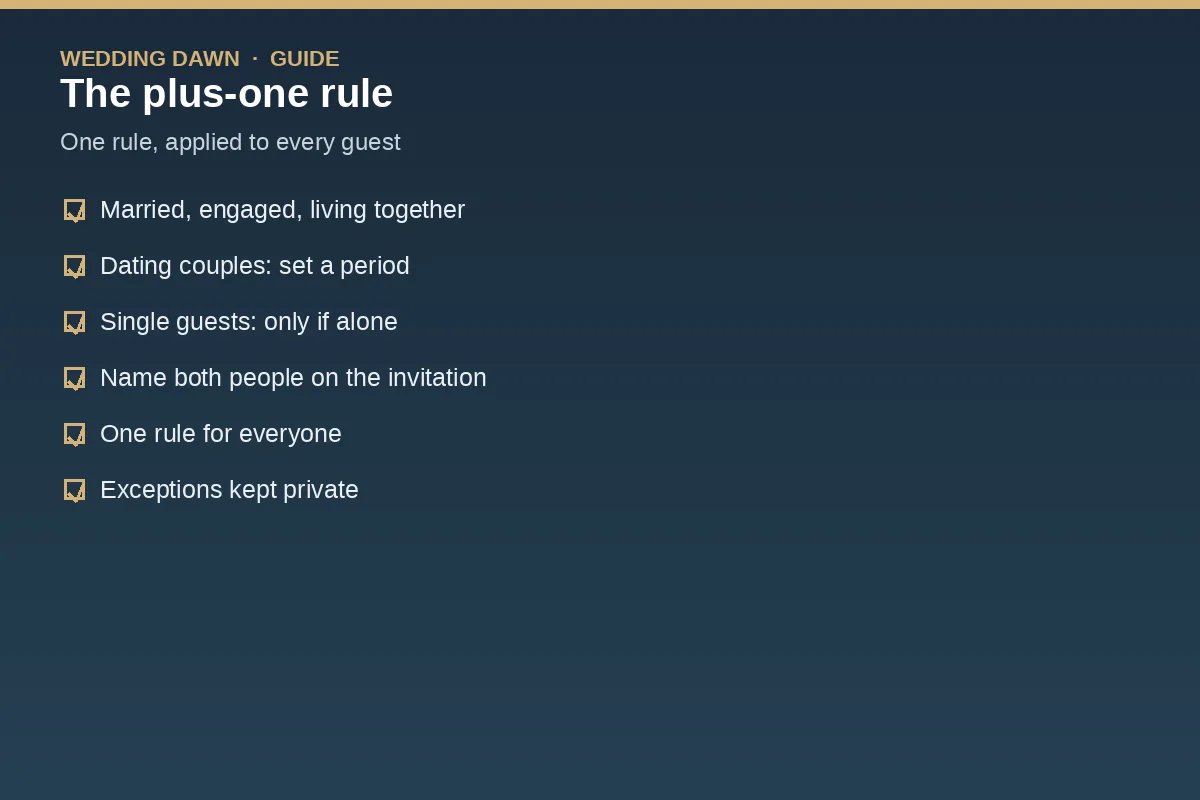
Choose a plus-one rule and apply it to everyone: married, engaged and living-together partners are invited by name; dating couples are invited together if they have been together longer than a set period or if you know the partner; single guests are not given a plus-one unless they will otherwise know no one. The exact rule matters less than its consistency.
Consistency is what protects you. The moment you make one exception, the list becomes a series of arguments about fairness, and every guest can name a couple who got one. If you must make an exception, make it quietly and do not discuss it. Announcing exceptions turns a private kindness into a public comparison.
Name both people on the invitation when a couple is invited. Writing and guest signals that the plus-one is optional or unwelcome, and it is the most common quiet insult on a wedding list. If you do not have the partner's name, ask before the invitation goes out.
Children: one age cutoff, applied to everyone
Decide whether children are invited, and at what age. Common cutoffs are under 12, under 16, or no children at all except immediate family. Whatever you choose, apply it without exception and state it clearly on the website and the rsvp. A rule that is explained once is easier to accept than a rule that seems to target one family.
Expect pushback, and do not argue it guest by guest. The answer is one sentence: we are keeping the wedding adults-only, and we understand if that means you cannot come. If you offer childcare, say how it works and who to contact. If you do not, say that too, early, so parents can plan.
Family expectations and who owns the conversation
Each family should have one spokesperson, not four. If your mother, your aunt and your grandmother all negotiate separately, you will get three different versions of the list. Ask one person per family to collect requests and bring them to you once, with priorities marked.
The couple makes the final decision, and each partner handles their own side. That is not a division of labour; it is a division of intimacy. Your partner can say no to your aunt in a way you cannot, and you can say no to their college friend without it becoming a family story. Never let one partner become the messenger for the other's family.
Coworkers, parents' friends, and the should list
The should list is the most expensive list, because it is made of people you would not invite if the wedding were private. A useful test: would you take this person to dinner and pay for it? If not, they belong on the C list, and the C list belongs behind the budget.
For coworkers, pick a rule: the whole team, the people you eat lunch with, or no coworkers at all. Inviting two people from a team of ten creates more friction than inviting none. For parents' friends, let the parents host a separate dinner or drinks rather than adding names to your seated dinner. It gives them the social moment without changing your number.
The B-list, without the insult
A B-list is normal; a visible B-list is cruel. Send A invitations early enough that declines arrive before the B invitations go out, and keep the B list small enough that the timing is not obvious. Never tell a B-list guest they were second choice, and never let a mutual friend explain the system.
If the wedding is small and the B-list is large, consider a second celebration: a casual party after the honeymoon, a dinner in another city, or a livestream with a clear invitation. A separate event is more honest than a tiered invitation that everyone can decode.
What to say when someone asks
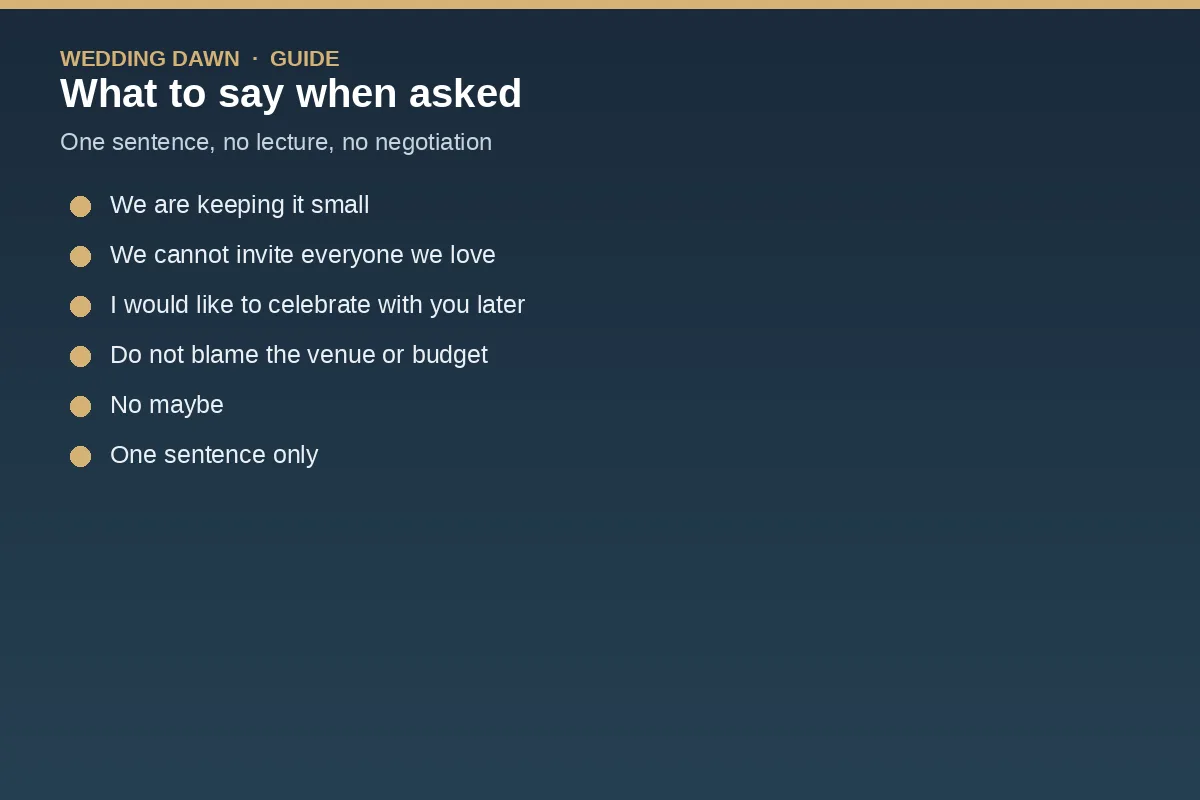
For a friend who assumes an invitation: we are keeping it small, and we are not able to invite everyone we love. I am sorry, and I would like to celebrate with you another time. Do not blame the venue, the budget or your mother; blame the decision, own it, and do not offer a maybe.
For a parent who adds names: we have a fixed number and we have finished the list. If you want to host a dinner for your friends, we would love to come. For a plus-one request: we are only able to invite partners we know, and we are applying that to everyone. One sentence, no lecture, no negotiation in the moment.
The list is also a seating chart
Every name becomes a seat, and every seat becomes a table. Before you finalise, do the table math: eight to ten per round table, two families who do not speak, one table of friends who only know the couple, and at least one table that can absorb a late addition. A list that cannot be seated is not final, however emotionally satisfying it is.
Mark the guests who must not sit together, the guests who need an aisle seat, and the guests who will leave early. That information belongs next to the name, not in someone's memory. The seating chart is where a guest list stops being abstract and starts costing real money and real hurt feelings.
When the list grows after invitations
It will. Someone gets engaged, a parent reconnects with a cousin, a friend assumes a plus-one. Hold a reserve of 5 to 10 seats and a clear rule for using them: first the immediate family, then the B-list in order, then no one. Do not reopen the whole list for one request; reopen the reserve.
If the venue allows more people but the budget does not, the answer is still no. Capacity is not the same as affordability, and a wedding that goes over budget to avoid one awkward conversation creates a longer awkwardness after the wedding. The list is one of the few places where a firm no is kinder than a slow yes.
A guest list is not a measure of how much you are loved. It is a plan for a room, a meal and a budget, made by two people who are allowed to choose. Decide the number, write the rule, tell the truth once, and let the rest be someone else's disappointment to manage.
Step by step
Write the number first
Seated capacity, per-head cost, invitation cost, plus a 10–15% buffer. Put it in a shared document both families can see.
Sort into A, B and C
A: wedding feels wrong without them. B: want them if space allows. C: obligation. Send A first and release B only after declines.
Choose the plus-one rule
One rule for everyone, written down. Name both partners on the invitation; never write and guest.
Set the children policy
One age cutoff, stated on the website and rsvp. Explain it once; do not argue family by family.
Do the table math
Eight to ten per table, known conflicts, aisle needs, early leavers. A list that cannot be seated is not final.
Quick checklist
- Seated capacity and per-head cost written down.
- Total number includes a 10–15% buffer.
- A/B/C tiers agreed by both partners.
- Plus-one rule written and applied consistently.
- Both partners' names on every couple invitation.
- Children policy and age cutoff stated publicly.
- One spokesperson per family collecting requests.
- Coworker rule chosen: whole team, lunch group, or none.
- B-list small enough that timing is not obvious.
- Reserve of 5–10 seats with a stated release rule.
- Table math done: conflicts, aisle seats, early leavers.
- One-sentence scripts agreed for common requests.
FAQ
How do we cut the guest list without hurting people?
Cut by rule, not by person. Set the number, choose a plus-one and children policy, and apply them consistently. Tell people the decision once, without blaming the venue or your family. Most hurt comes from inconsistency and from a slow maybe, not from a clear no.
Do we have to invite plus-ones?
No, but you need one rule. A common approach is to invite partners who are married, engaged or living together, and to give single guests a plus-one only if they would otherwise know no one. Name both people on the invitation and apply the rule to every guest.
Is it rude to have a B-list?
A B-list is normal planning; a visible B-list is rude. Send A invitations early, keep B small, and never tell a guest they were second choice. If the gap is large, consider a separate celebration rather than a tiered invitation everyone can decode.
How do we handle parents who want to add guests?
Give each family one spokesperson and a deadline. Explain the fixed number and the closed list, then offer an alternative: a dinner or drinks hosted by the parents. Do not negotiate name by name, and do not let one partner become the messenger for the other's family.
What if someone assumes they are invited?
Answer quickly and kindly: we are keeping it small and cannot invite everyone we love; I am sorry, and I would like to celebrate with you another time. Do not blame the budget or the venue, and do not offer a maybe that keeps the hope alive.
Sources
- FTC Consumer Advice — shopping for a wedding or event Deposits, contracts and cancellation terms; checked 2026-11.
- Emily Post Institute — wedding guest list etiquette Plus-one, children and invitation etiquette guidance; checked 2026-11.
- The Knot — wedding guest list guide Capacity, B-list and guest-count planning; checked 2026-11.