Wedding Favors Guests Actually Take Home
Wedding favors have a strange reputation. Guests remember the good ones for years and cannot name the bad ones a week later, yet almost every couple loses a weekend worrying about them. The fix is not a bigger budget or a cleverer object; it is deciding what the favor is for. A favor is a thank-you that travels home with someone. If it cannot travel, cannot be used and cannot be eaten, it is packaging with a bow on it.
Start with the question guests ask
Before comparing suppliers, ask what your guests will do with the object on Monday morning. A jar of good honey goes on toast. A small succulent goes on a windowsill. A personalised keyring goes into the drawer with the other keyrings. That is not a judgment about taste; it is a fact about how people live. The most useful favors fit in a coat pocket or a handbag, survive a two-hour drive, and do not require instructions.
There is also a quiet arithmetic to favors that most checklists ignore. You are not buying one object per guest; you are buying an object, a bag, a label, a card and a spare for every twelve guests. The favor that looks affordable per unit becomes expensive per person once packaging and waste are counted, and the favor that looks expensive per unit can be the cheaper choice if it replaces both a gift and a place card. Decide which job it is doing before you fall in love with a supplier photo.
The three-part test
Run every idea through three questions and keep only what passes at least two. Is it consumable, so that using it does not create a permanent obligation? Is it useful in a way the guest would have bought anyway? Is it personal enough to feel chosen rather than bulk-ordered? Edible favors pass the first test almost automatically. Practical favors pass the second. Very few mass-produced items pass the third, which is why a well-chosen food item usually beats a personalised trinket.
- Consumable: local honey, good chocolate, coffee roasted that month, tea, olive oil, a spice blend with a recipe card.
- Useful: a sturdy tote, a compact umbrella, a decent bottle opener, seed packets with clear sowing instructions.
- Personal: a recipe card in your own words, a handwritten name on each tag, a donation card that names the cause and the amount.
Do the math before you commit to an object
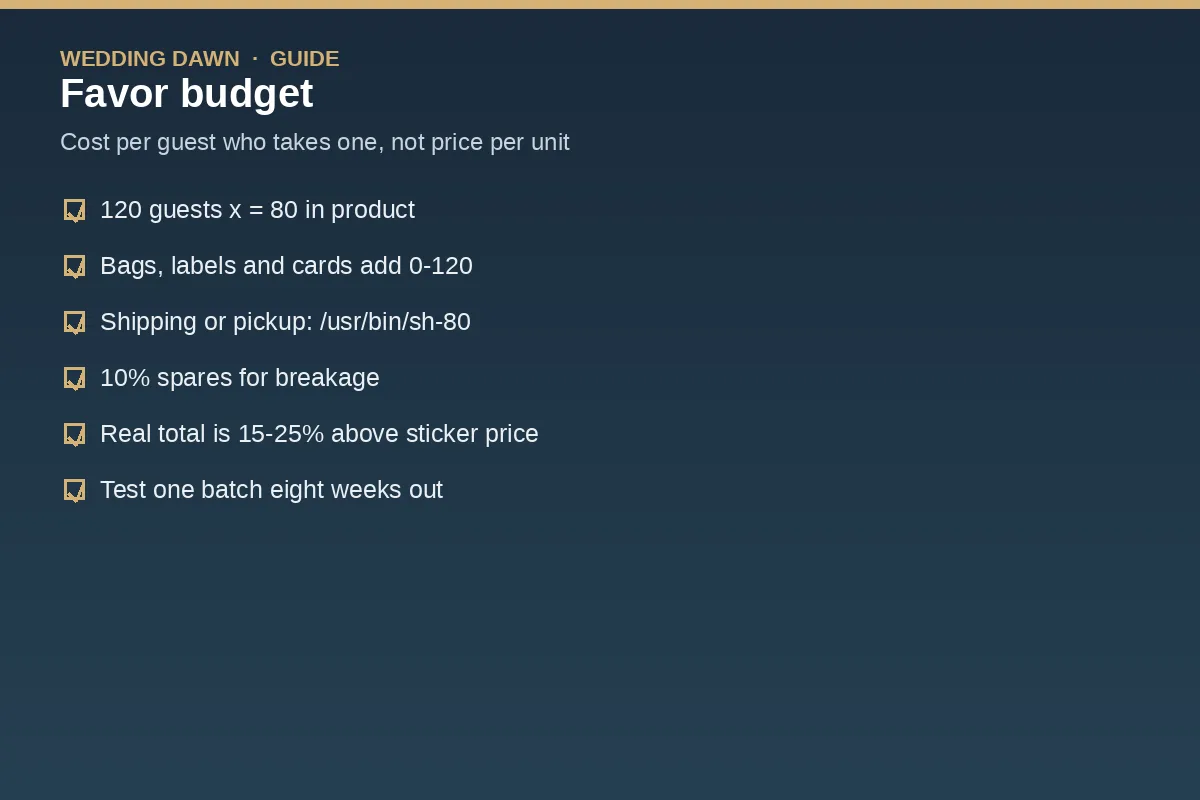
Favors typically land between one and three percent of a wedding budget, which sounds small until you multiply by headcount. At 120 guests, three dollars per favor is 360 before packaging, shipping and the extra ten percent you will order because something always arrives cracked. Five dollars becomes 600. The number that matters is cost per guest who takes one home, not cost per unit. Divide the total by the number of guests who will actually take one, add packaging, and compare that figure with a better version of a cheaper idea.
- 120 guests at 4 per favor: 480 in product alone
- Bags, labels and cards: often 60 to 120 more
- Shipping or a second pickup trip: 0 to 80 depending on weight
- Ten percent spares for breakage and late additions
- Real total is usually 15 to 25 percent above the sticker price
Formats that survive the trip home
Five formats earn their place again and again. Edible gifts are the safest: local honey, good chocolate, coffee beans roasted that month, a small bottle of olive oil, a spice mix with a recipe card. Practical objects work when the quality is genuinely good, because a flimsy tote insults the guest more than no tote at all. Plants and seeds suit spring and garden weddings, provided the pot survives a car ride. Donations in the guest's name suit couples who already have a home full of things, but only when the card says exactly where the money went. Experiential favors, such as a photo print or a late-night snack, work when they happen during the event rather than after it.
The packaging decides whether any of this is appreciated. A paper band, a compostable box or a plain kraft bag does the job; plastic boxes with printed sleeves look expensive and go straight into the bin. If you buy from local makers, ask whether they supply unpackaged or in plain cases, and whether they will take back unused stock. For edible gifts, check allergen labelling rules where you live: most places expect a clear ingredient list on a home-made food gift, and some venues do not allow outside food at all.
Formats that end up in a drawer
The failure modes are predictable. Engraved trinkets, monogrammed coasters and miniature picture frames are beautiful in photographs and useless in real life. Candles in thin glass arrive cracked or scented like a hotel lobby. Favors that double as escort cards create a queue at the seating chart and a scramble when one goes missing. Anything requiring assembly on the wedding morning will be assembled badly, usually by the one person who should be resting. Anything small enough to be a choking hazard needs a separate, clearly labelled alternative for children.
One per guest or one per household?
Count households, not heads. Two adults who live together need one jar of honey, not two, and a couple with children needs one favor plus something for each child. For edible items, one per household is generous and halves the bill. For practical items used individually, such as umbrellas or fans, one per guest makes sense. Write the number down before ordering, then add ten percent. Suppliers sell in dozens, and running out is the one mistake guests notice immediately.
DIY, honestly costed
Making favors yourself can save money or cost more than buying, depending on what you count. Materials are the visible cost; time, trial batches, failed batches and storage are the invisible ones. A jam favor sounds charming until you price jars, lids, fruit, labels and four evenings of stirring, then discover forty jars will not fit in the fridge. DIY works best when the thing is simple, shelf-stable and made in a batch you can test a month ahead. It works worst when it involves glass, heat and a deadline.
- Test one batch eight weeks ahead and time it honestly
- Buy 15 percent extra jars or boxes for breakage
- Choose recipes that keep a month without refrigeration
- Label with the date made and any allergen in plain words
A timeline that avoids the 1 a.m. assembly line
Favors are a small project with a long lead time, and almost every disaster comes from compressing it into the final week. Work backwards from the wedding date.
- Ten weeks out: choose the format and confirm the per-head budget
- Eight weeks out: order samples, taste or test them, check allergens
- Six weeks out: place the full order with ten percent spare
- Four weeks out: print labels and cards, confirm the delivery date
- Two weeks out: assemble in one session with two helpers, not alone
- One week out: pack into labelled boxes by table, deliver to the venue
Distribution on the day
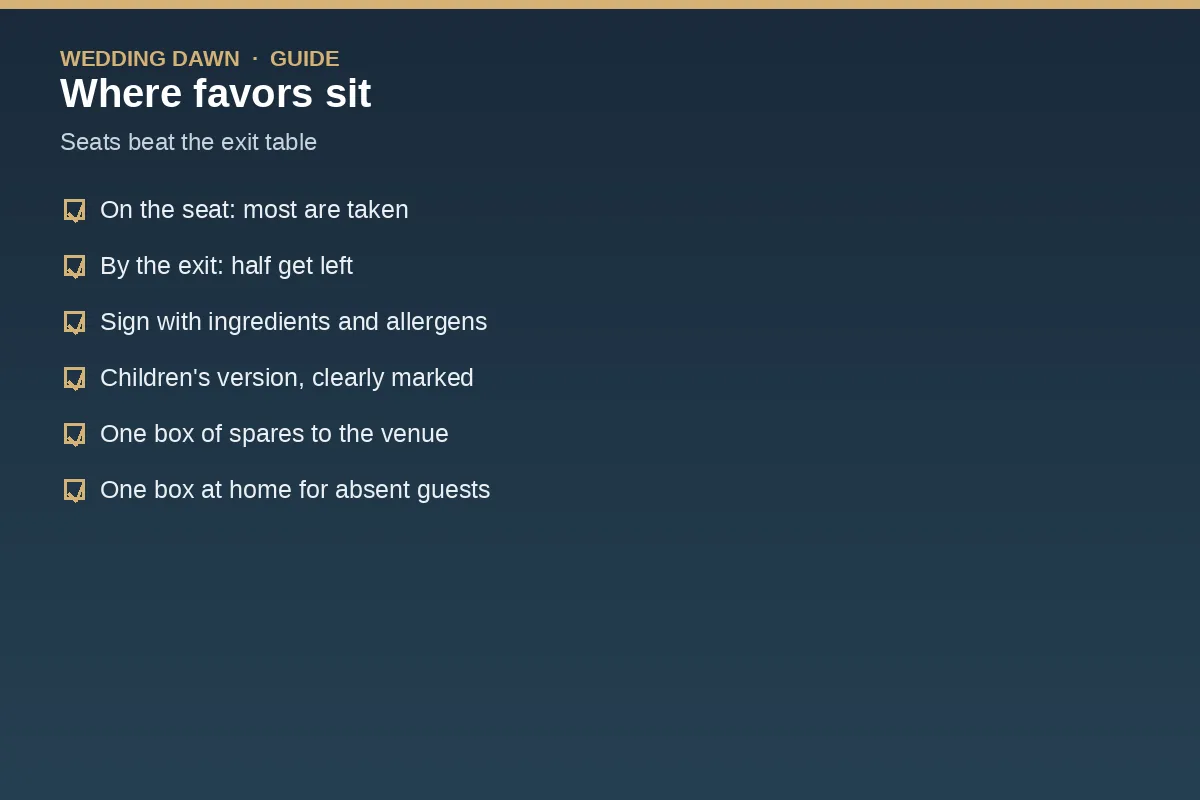
Where the favor sits changes how many go home. Placed on the seat, most are taken. Stacked by the exit, roughly half are left behind, and the leftovers end up in your car. If you use a display table, put a small sign saying what the item is and whether it contains nuts, alcohol or caffeine; guests with allergies will not ask. Give the venue or planner one box of spares and keep one at home for the people who could not come.
When the budget is close to zero
A favor is optional. If the money is not there, skipping favors entirely is better than buying something that will be thrown away. Guests notice food, seating and how long they waited for dinner far more than whether they received a gift. If you want a token, a handwritten note at each place setting costs almost nothing and is kept more often than a keyring. Couples who want to give something without spending per head can put a single donation card on the gift table, clearly worded, and let it speak for both of them.
The best favors are not the most original. They are the ones a guest uses on Tuesday and mentions the following month, which almost always means something edible, something genuinely useful, or something that gave money to a cause the couple cares about. Decide that first, and comparing suppliers becomes much shorter.
Choose and ship favors in five steps
Set the per-guest ceiling
Take 1 to 3 percent of the budget, divide by the number of guests who will take one home, and treat that as a hard ceiling including packaging.
Pick a format that passes two tests
Consumable, useful or personal: choose something that passes at least two, and reject anything that needs instructions.
Count households, then add spares
Order one per household for food, one per guest for individual items, plus ten percent for breakage and late additions.
Test before the full order
Order samples eight weeks out, taste or use them, and check allergen labelling and venue rules on outside food.
Place, label and sign the table
Put favors on seats rather than by the exit, and add a small sign listing ingredients and allergens.
Favor checklist
- Format chosen and it passes at least two of the three tests
- Budget calculated per guest who takes one home, packaging included
- Household count written down, not headcount
- Order placed six weeks out with ten percent spare
- Samples tasted or tested before the full order
- Allergen and ingredient list written in plain words
- Venue rules on outside food confirmed
- Packaging is paper, compostable or reusable, not plastic
- Labels printed with date made where relevant
- Assembly scheduled with two helpers, two weeks out
- Boxes packed and labelled by table before delivery
- Small sign for the display table listing ingredients
- Children's alternative prepared and clearly marked
- One box of spares kept at home for absent guests
Frequently asked questions
How much should we spend on wedding favors?
One to three percent of the total budget is the usual range, which at 120 guests means roughly 360 to 700 including packaging. Work out cost per guest who takes one home rather than per unit, because packaging, shipping and spares add 15 to 25 percent.
Are wedding favors still expected?
In many circles they are a nice extra rather than an obligation. Guests remember food, seating and timing far more than a gift. If the budget is tight, a handwritten note at each place setting is a better use of money than a batch-ordered trinket.
What is the most popular favor right now?
Edible local items: honey, chocolate, coffee, olive oil and spice blends. They are consumable, travel well, suit most diets if labelled, and do not need to be stored forever. Practical objects such as good totes or umbrellas come second.
Should favors be one per person or one per couple?
For food and drink, one per household is generous and halves the cost. For items used individually, such as fans or umbrellas, give one per guest. Always add ten percent for breakage and late additions.
Do we need to label homemade favors?
Yes. Write the ingredients and any allergen in plain words, plus the date made. Most venues also require this, and guests with allergies will not ask. If alcohol is included, say so clearly.
When should we order favors?
Place the full order six weeks before the wedding, after tasting or testing samples at eight weeks. Assemble two weeks out with help, and deliver to the venue one week before so nothing is packed in a hurry.
See all frequently asked questions →
Sources
- The Knot — Wedding favor etiquette and ideas Etiquette positions on whether favors are expected and how many to order; checked 2026-11.
- Brides — Wedding favor budget guidance Typical share of budget and per-guest spending ranges referenced in the budget section; checked 2026-11.
- FDA — Food allergen labelling basics Allergen and ingredient labelling expectations for edible gifts; checked 2026-11.