Wedding DJ vs Band: Cost, Energy & How to Choose
Choosing between a wedding DJ and a live band is one of the few entertainment decisions that changes the entire feeling of the night. A DJ can play any song ever recorded and never needs a break; a live band turns the room into a concert and gives you energy a laptop cannot fake. Neither is simply 'better'. The right answer depends on your crowd, your venue's sound and space limits, how much you want to spend, and the kind of memories you want to dance to. This guide walks through the real trade-off, where each option wins, what you actually pay, how to choose for your specific night, and the mistakes that quietly empty the floor.
The real trade-off, in plain terms
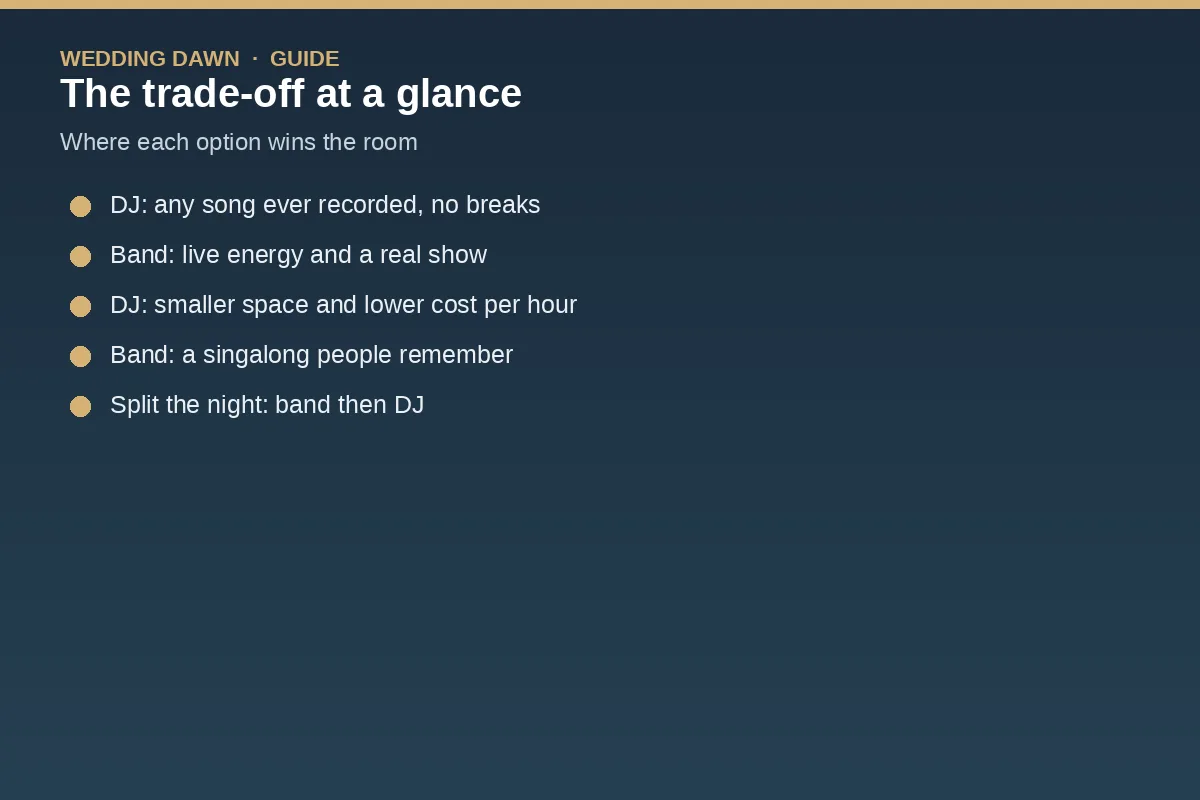
Strip away the marketing and the choice is about control versus presence. A DJ gives you total control over the exact playlist, flawless transitions between genres, and the ability to read the room and pivot in seconds when a song dies. A band gives you presence: real musicians, real instruments, and a show people remember even if the set list is fixed. If your priority is 'every guest hears their song', lean DJ. If your priority is 'the room feels alive and special', lean band. Most couples actually want both, which is why a DJ who can also host and a band who can cover your first dance are both common compromises.
- DJ: total playlist control, instant genre switches, no breaks.
- Band: live energy, a real show, and a memory people talk about.
- Ask which matters more: the exact songs, or the live feeling.
- Many couples split the night: band for dinner, DJ for late dancing.
Where a DJ wins — and where a band fights back
A DJ wins on range and logistics. One person can cover ceremony, cocktail, dinner, and the late party with the same gear, carry 50,000 songs, take requests on the spot, and keep the music going through every transition without a gap. A band fights back on atmosphere: a four-piece band playing a Motown or pop set creates a lift that makes grandparents and twenty-somethings stand together. The catch is set lists. A band typically plays 45-minute sets with 15-minute breaks, needs a larger stage and more power, and cannot play a song it has not rehearsed. A good band will learn your first-dance song; a DJ will play it perfectly the first time, every time.
Cost: what you actually pay per hour
Music is rarely the most expensive line on the budget, but the price gap between options is wider than people expect. A wedding DJ commonly runs from about $800 to $2,500 for the full evening, with experienced headliners higher; a four- to five-piece band commonly runs $2,500 to $7,000 or more, and an eight-piece with horns climbs fast. The number that matters is cost per hour of actual dancing, not the headline. A DJ who covers the whole day is often cheaper per hour than a band that plays two 45-minute sets. Always ask what is included: sound system, lighting, MC duties, travel, and overtime after a set end time. A 'cheap' band that needs you to rent a stage, extra mics, and a sound engineer stops being cheap quickly.
- DJ full evening: roughly $800-$2,500; headliners more.
- Band 4-5 pieces: roughly $2,500-$7,000+; bigger climbs fast.
- Compare cost per dancing hour, not the headline number.
- Confirm sound, lighting, MC, travel, and overtime in writing.
Match the choice to your crowd and venue
Your guests decide the winner more than your taste does. A younger, request-happy crowd that wants hip-hop, reggaeton, and 2020s pop will usually be happier with a DJ who can switch languages and decades on a dime. A crowd that loves a singalong, a horn line, and a show will light up for a band. Venue rules matter just as much: historic barns, tiny lofts, and outdoor sites may cap band size, ban amplified sound after a certain hour, or lack power for a full rhythm section. Always check the venue's noise curfew, load-in path, and stage space before you promise a band. A DJ fits almost any room; a band needs the room to fit it.
Make either option sound its best
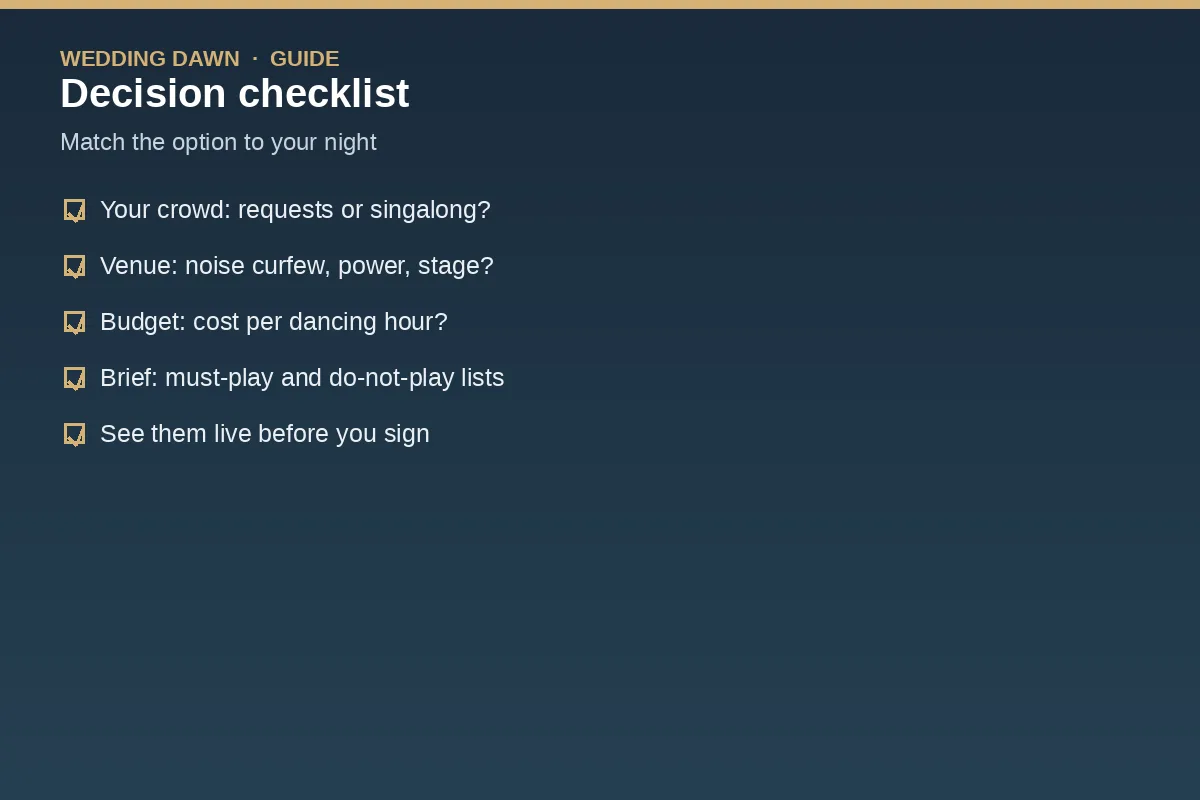
Whoever you book, the result depends on the brief you give. Send a do-not-play list and a must-play list a month ahead, with the songs that mean something to your families, not just the charts. For a band, agree the exact first-dance and parent-dance songs in writing and confirm they will perform them live, not lip-sync to a track. For a DJ, confirm they will act as emcee for announcements, because a great playlist with a missing cue for cake-cutting leaves the moment flat. Visit a live show before you sign — a band's rehearsal video and a DJ's recorded mix both hide the room-reading skill that separates a good night from a great one.
Questions worth asking every candidate
The questions you ask reveal more than the demo reel. For a DJ, ask how they handle a dead song — do they read the floor and switch, or push their own set? Ask whether they act as emcee for the key moments, and whether they take requests from guests or guard a fixed list. For a band, ask how many full sets they play, what the breaks sound like (a playlist, or silence?), and whether they learn specific songs beyond the first dance. For both, ask for two or three recent weddings like yours and whether they carry backup gear and a contingency if someone is ill. The couples who end the night happy are the ones who asked the awkward questions in the booking call, not the ones who trusted the highlight video.
Book early, or risk the short list
Strong DJs and bands book out twelve to eighteen months ahead in popular seasons, and the best ones in your budget often go first. Start the search as soon as you have a date and a venue, because the venue's sound limits and curfew shape who is even possible. Lock the contract once you have heard them live and compared itemized quotes, and put the must-play and do-not-play lists in writing well before the day. If you are planning on short notice, be flexible on the exact act but firm on the brief: a solid DJ with a tight list beats a famous band that ignores your room. A clear timeline — search, see live, sign, brief — keeps music from becoming a last-minute panic that shows on the dance floor.
- Start the search once date and venue are set.
- See at least one live show before you sign.
- Compare itemized quotes, not highlight reels.
- Put must-play and do-not-play lists in writing early.
The hybrid option worth considering
You do not have to pick only one. The most reliable nights often blend both: a band for the ceremony, cocktail hour, and dinner where live music feels special, then a DJ for the late party when the floor needs non-stop energy and a deep request list. Some bands even offer a 'band-plus-DJ' package where the musicians play live sets and a built-in DJ covers the breaks and the after-party, so you never hear silence. If your budget allows only one, bias toward the format that fits your crowd's age mix and your venue's limits; if it allows both, the hybrid keeps the early evening intimate and the late night full. Decide the handoff time in writing so the two acts hand over cleanly between sets.
Mistakes that quietly empty the dance floor
The common ones are predictable. Booking a band whose style clashes with your crowd, then watching the floor thin during every break. Hiring a DJ who only plays their own genre and ignores requests, so the older guests sit down by ten. Forgetting the emcee role, so key moments have no cue and the energy dips. Skipping the venue sound check, then fighting feedback all night. And splitting the night without telling either vendor the handoff time, so you get a five-minute silence between sets. None of these is about talent; they are about briefing, logistics, and knowing your room — exactly what this guide is meant to hand you before you sign.
Step by step
Name your priority
Decide whether exact songs or live energy matters more before you talk to anyone.
Check the venue first
Confirm noise curfew, power, load-in, and stage space so a band is even possible.
Get itemized quotes
Compare DJ and band by cost per dancing hour, including sound, lights, MC, travel, overtime.
Send a tight brief
Share do-not-play and must-play lists a month ahead; confirm first-dance handling in writing.
See them live, then sign
Watch a real show to judge room-reading, not just the recorded mix, before you pay.
Quick checklist
- Matched the option to your crowd, not just your taste.
- Confirmed the venue allows a band: noise curfew, power, stage.
- Compared cost per dancing hour with sound, lights, MC, travel included.
- Sent do-not-play and must-play lists a month before the day.
- Watched a live show and confirmed first-dance handling in writing.
FAQ
Is a DJ cheaper than a band?
Usually yes per dancing hour. A DJ covers ceremony through late party with one fee, while a band of four or five costs more and plays shorter sets with breaks. Compare the written cost per hour of actual dancing, not the headline price.
Can a band play my first-dance song?
Most professional bands will learn one or two specific songs, including your first dance and parent dances, if you confirm them in writing well ahead. Always ask whether it will be performed live or with a backing track.
What if the venue bans loud music after 10pm?
Then a full band may be impossible. A DJ with lower volume and in-ear monitoring, or an acoustic duo, often fits tighter noise rules. Check the curfew and stage limits before you promise any live act.
Should I book both a DJ and a band?
Many couples do: a band for dinner and early dancing, a DJ for the late party when energy needs to stay high and requests pile up. If you split the night, tell both vendors the exact handoff time to avoid a silent gap.
Do I need to provide a sound system?
For a DJ, almost never — it is included. For a band, confirm whether their quote includes PA, monitors, and mics; smaller bands may expect you to rent part of the rig, which changes the real cost fast.
Sources
- The Knot — wedding DJ and band cost guide Typical price ranges for wedding DJs and live bands by region; checked 2026-11.
- WeddingWire — entertainment vendor checklist What to confirm in a music contract: sound, lighting, MC, overtime; checked 2026-11.
- NAMM / live-event production guidance Power, stage, and sound requirements for live bands at events; checked 2026-11.