Wedding Day Timeline, Hour by Hour
Wedding-day schedules usually fail in the same place: the gap between the last hair appointment and the ceremony. Everything before that gap is written as one vague block called morning, and everything after it is written as a wish. The day then runs twenty minutes late before lunch and an hour late by the speeches.
A timeline is not a list of events. It is a budget of time, with buffers placed around the few things that cannot move: the ceremony start, sunset, the venue curfew and the caterer's service window. Fix those points first, then fit the rest of the day between them. The numbers below are starting points drawn from ordinary vendor practice. Replace them with the real timings your photographer, caterer and venue give you, because their constraints outrank any template.
Fix the immovable points first
Before you write a single clock time, list what cannot move. The ceremony start agreed with your officiant and venue. The sunset time for your date and location. The hour the venue wants guests out, and any noise curfew. The earliest and latest times your caterer will serve dinner, including the minimum service hours in the contract. Vendor load-in and load-out windows. The departure time of any transport you have booked.
Sunset matters more than most couples expect. Look it up, subtract forty minutes, and protect that window. Golden-hour portraits cannot be moved to after dessert, because the light is gone. If sunset falls in the middle of dinner, either serve earlier or plan a ten-minute exit between courses and warn the caterer and the MC in advance.
Write these fixed points at the top of one page. Every later decision is easier once they are visible, because you stop arguing about preferences and start solving a scheduling problem with real edges.
Work backwards through the ceremony
Guests typically arrive thirty to forty minutes before a ceremony and need to be seated ten minutes before it begins. Ushers need fifteen calm minutes before that. For a four o'clock ceremony, the doors open at 3:20, seating starts at 3:50, and the processional begins at 3:58.
The ceremony itself usually runs twenty to thirty minutes. A receiving line adds fifteen to twenty, and many couples now skip it, greeting guests during cocktail hour instead. Group photographs with immediate family need thirty to forty-five minutes, and that time has to come from somewhere: either cocktail hour runs long, or the couple joins it late, which is normal as long as guests are told.
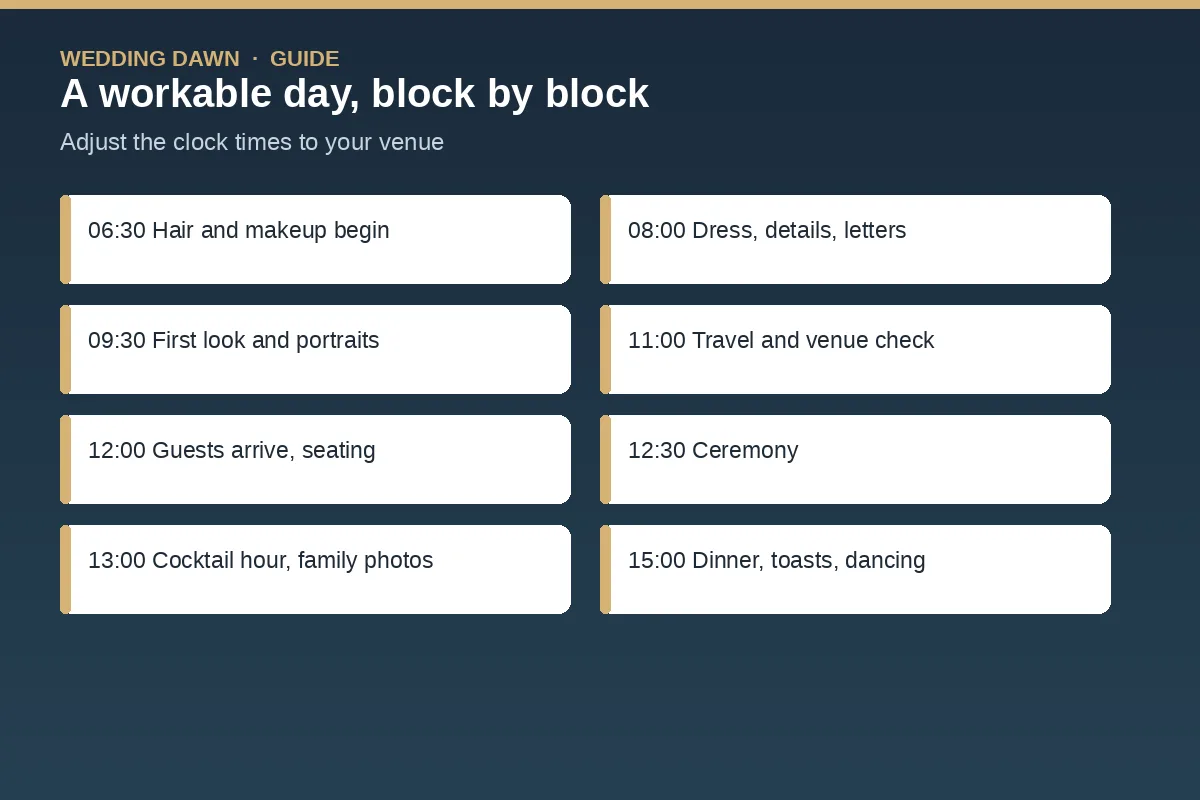
Then check the bridge to the reception. If the ceremony and reception are in different places, add travel time twice: once for the wedding party, once for guests driving themselves and parking. Twenty minutes of driving plus ten minutes of parking plus five minutes of walking is thirty-five minutes, not twenty.
Getting ready is a production line
Hair takes forty-five to sixty minutes per person, and makeup takes about the same. For a party of six with two artists, that is three to four hours of chair time before anyone has zipped a dress. The trial is where you learn your real numbers: time your own hair and makeup, then add ten minutes per person for nerves, pins and adjustments.
Sequence matters as much as duration. The person whose hair holds least well goes last. The couple should not be last in the chair, because every delay then lands directly on the ceremony. Build a twenty-minute buffer before the first look or before the dress goes on, and write the getting-ready plan as appointments with names and clock times.
- Details photographs, rings, invitations and shoes: 20 to 30 minutes
- Dress, shoes and jewelry, with one person helping: 15 minutes
- First look, including the reaction and a few portraits: 20 to 30 minutes
- Portraits as a couple: 30 to 45 minutes
- Family combinations: 20 to 30 minutes, with a list of names
- Travel to the ceremony: driving time plus parking plus walking
Give everyone in the room the same one-page plan. A schedule that lives only in the planner's folder is a schedule nobody follows.
Cocktail hour and dinner
Cocktail hour is sixty minutes, and it exists for two reasons: guests need something to do while photographs happen, and the kitchen needs a fixed moment to start plating. Protect the full hour. If photographs run over, extend the hour rather than shortening dinner, and tell the caterer at the sixty-minute mark.
A plated three-course dinner usually takes forty-five to sixty minutes: fifteen to twenty for the starter, twenty-five to thirty-five for the main, fifteen for dessert. A buffet takes longer to move everyone through even though the kitchen is faster. Ask your caterer which service fits your room and guest count instead of assuming.
Speeches work best before the main course, while people are seated and attentive. Three or four speakers at three minutes each is a comfortable maximum. After dessert, attention moves to coffee, the bar and the dance floor, and a long toast set drains the room.
Watch the bar as well as the kitchen. One bar for a hundred and twenty guests creates a queue that eats the cocktail hour and delays seating; a second bar, or a pre-poured welcome drink, fixes it for very little money. Ask the venue how many bartenders they staff per hundred guests and where the line will form.
- Cocktail hour: 60 minutes, with a signature drink and one passed snack
- Seating: 10 minutes, with a seating chart at the door
- Entrances and first dance: 8 to 10 minutes in total
- Starter: 15 to 20 minutes
- Speeches: 12 to 15 minutes for three or four speakers
- Main course: 25 to 35 minutes
- Dessert and cake cutting: 15 to 20 minutes
- Open dancing: whatever remains before the curfew
Give the clock an owner
One person, not three, owns the timeline on the day. Usually that is the planner or the MC, holding a printed copy with the kitchen number on it. The couple should not be checking the time; they should be the last to learn that the day is running late.
Agree on a slippage signal: a quiet word to the MC at ten minutes behind, a decision at twenty. Write the cut list in advance. What goes first if the day runs late? The receiving line, the second portrait location, the extended family combinations, the dessert table, the sparkler exit. Deciding this on paper turns a crisis into an adjustment.
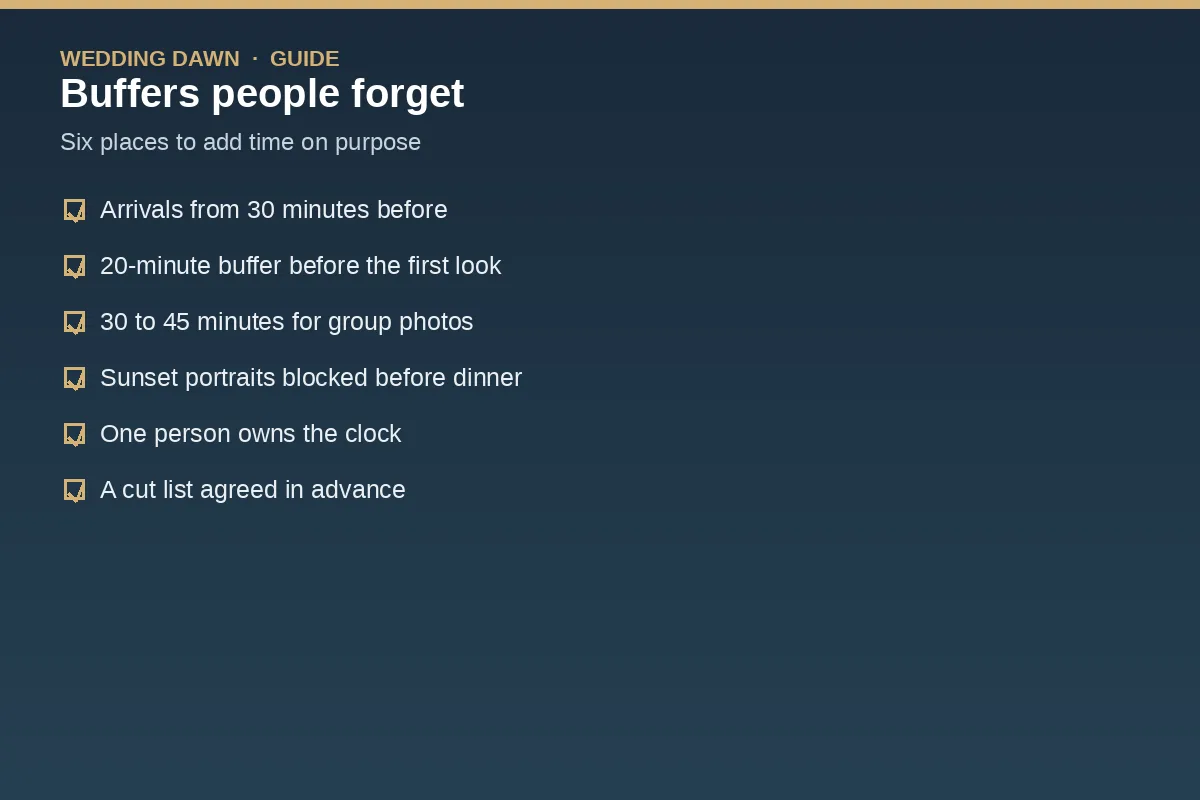
Spread the buffer through the day rather than saving one large cushion for the end, where it cannot help. Ten minutes before the ceremony, ten before dinner, ten before portraits: small gaps that each absorb a small problem.
Different shapes for different days
A lunchtime wedding compresses the same logic into fewer hours. The ceremony moves to late morning, portraits happen in harsher overhead light and need shade or a covered walkway, and the whole event may finish before the light gets good. In that case, consider a short portrait session the evening before, and accept that the day itself will lean on documentary photographs rather than golden-hour romance.
An evening wedding has the opposite problem: the ceremony can start late only at the cost of the portraits, because the sun sets on a schedule that has nothing to do with your planner. Count backwards from sunset first and place the ceremony after it, using candlelight and a well-lit room for the group photographs. The order of the day changes; the method does not.
The blocks people forget
Vendor meals and breaks. A walk-through of the room before doors open. The bathroom stop that takes fifteen minutes in a dress. The group photograph that needs someone to find an uncle. The car that cannot reach the door because guests parked in the loading zone. None of this is dramatic, and all of it costs ten minutes.
Plan the end as carefully as the start. Gifts, cards, the dress and any rented items need a named person and a vehicle. A day that runs beautifully and then loses the card box still ends badly.
The mistakes that cost the most
- Scheduling the couple's hair and makeup last, so every earlier delay lands on the ceremony
- No travel buffer between ceremony and reception
- Sunset portraits placed during dinner
- Three people managing time and nobody owning it
- Unlimited speeches, or speeches after dessert
- Photographer and videographer not given the schedule in advance
- Ignoring the venue curfew and the caterer's service window until the last week
- No printed copies, only a phone document
A good timeline looks slightly boring on paper. That is the point. The day should feel unhurried because the plan already spent its buffer, not because nobody was watching the clock.
Step by step
List the fixed points
Ceremony start, sunset, venue curfew, caterer service window, vendor load-in and transport departure. Put them at the top of one page.
Count backwards from the ceremony
Doors thirty to forty minutes before, seating ten minutes before, processional two minutes before. Then place cocktail hour and dinner behind it.
Time the getting-ready block
Use your trial timings, add ten minutes per person, put the couple second to last and keep a twenty-minute buffer before the first look.
Protect the photo windows
Thirty to forty-five minutes for group photos, and a separate sunset slot that never lands on top of dinner service.
Name one clock owner and a cut list
One printed schedule, one person allowed to call the delay, and a written order of what gets cut first.
Quick checklist
- Fixed points written on one page and shared with the venue and caterer.
- Sunset time checked for the date and location, with a forty-minute portrait window.
- Ceremony doors, seating and processional times fixed.
- Travel time counted twice, including parking and walking.
- Hair and makeup timings taken from the trial, plus ten minutes per person.
- Couple not scheduled last in the chair.
- Twenty-minute buffer before the first look or the dress.
- Group photo list with names, and thirty to forty-five minutes blocked.
- Cocktail hour kept at a full sixty minutes.
- Speeches limited to three or four speakers before the main course.
- One printed schedule with the kitchen number, held by one person.
- Cut list agreed in writing before the wedding morning.
FAQ
How long should a wedding day timeline be?
From the start of getting ready to the last dance, most full-day weddings run ten to twelve hours. A lunchtime wedding can fit in six or seven. The length matters less than the gaps: keep ten to twenty minutes of buffer before the ceremony, before dinner and before portraits.
What time should the ceremony start?
Work backwards from sunset and from your venue curfew rather than picking a round number. If you want golden-hour portraits, the ceremony should end roughly ninety minutes before sunset, which leaves time for congratulations, group photos and a short couple session.
How long does hair and makeup take for a bridal party?
Plan on forty-five to sixty minutes per person for hair and the same for makeup. Two artists can usually handle five or six people in three to four hours if the schedule is written as appointments. Trial timings are more reliable than averages.
Should we do a first look?
A first look buys thirty to forty-five minutes of portraits before the ceremony and removes the pressure from cocktail hour. Couples who prefer the aisle reaction can still take portraits afterwards, but should extend cocktail hour and tell guests why the couple is late.
When should speeches happen?
Before the main course is the safest slot: guests are seated, the food is not yet cooling and attention is available. Three or four speakers at three minutes each is plenty. Speeches after dessert compete with coffee, the bar and the dance floor.
What do we cut if the day runs late?
Cut in this order: the receiving line, the second portrait location, extended family combinations, the dessert table, the sparkler exit. Decide the order before the wedding and give it to the person holding the schedule, so nobody has to negotiate in the moment.
Sources
- timeanddate.com — sunrise and sunset calculator Sunset times used to place golden-hour portraits; checked 2026-11.
- FTC Consumer Advice — shopping for a wedding or event Vendor contracts, deposits and service terms; checked 2026-11.
- NACE — National Association for Catering and Events Catering service sequencing and staffing practice; checked 2026-11.