Wedding Cake Guide: Cost, Servings, Desserts

A wedding cake is the only line on the checklist that guests photograph before they taste it. That is exactly why the decision goes wrong: it gets made as an image, quoted as a slice price, and delivered as a project with its own vendors, timings and failure modes. Couples end up debating fondant while nobody has counted how many people will actually eat a piece. This guide separates the cake into two jobs, the ceremonial centerpiece and the dessert service, and prices each one honestly so you can decide how much ceremony you want and how much dessert you need.
Two decisions, not one
A cake is asked to do two unrelated jobs. The first is ritual: a tall, photogenic object that gets cut while someone takes pictures. The second is dessert: enough portions, at the right temperature, for people who have already eaten dinner. Almost every overspend comes from trying to make one object do both jobs at full size. A three-tier cake for 120 guests is a sculpture that happens to be edible, and it is also the most expensive way to serve 120 portions of sponge. Decide which job matters more. If the photograph matters, buy a small, beautiful cake and serve a sheet cake from the kitchen. If dessert matters, build a dessert table and keep a single tier for the cutting moment. If both matter, budget for both, which is still usually cheaper than one enormous cake. Ask your venue how many couples order a second kitchen cake; the answer is usually most of them.
What a slice actually costs
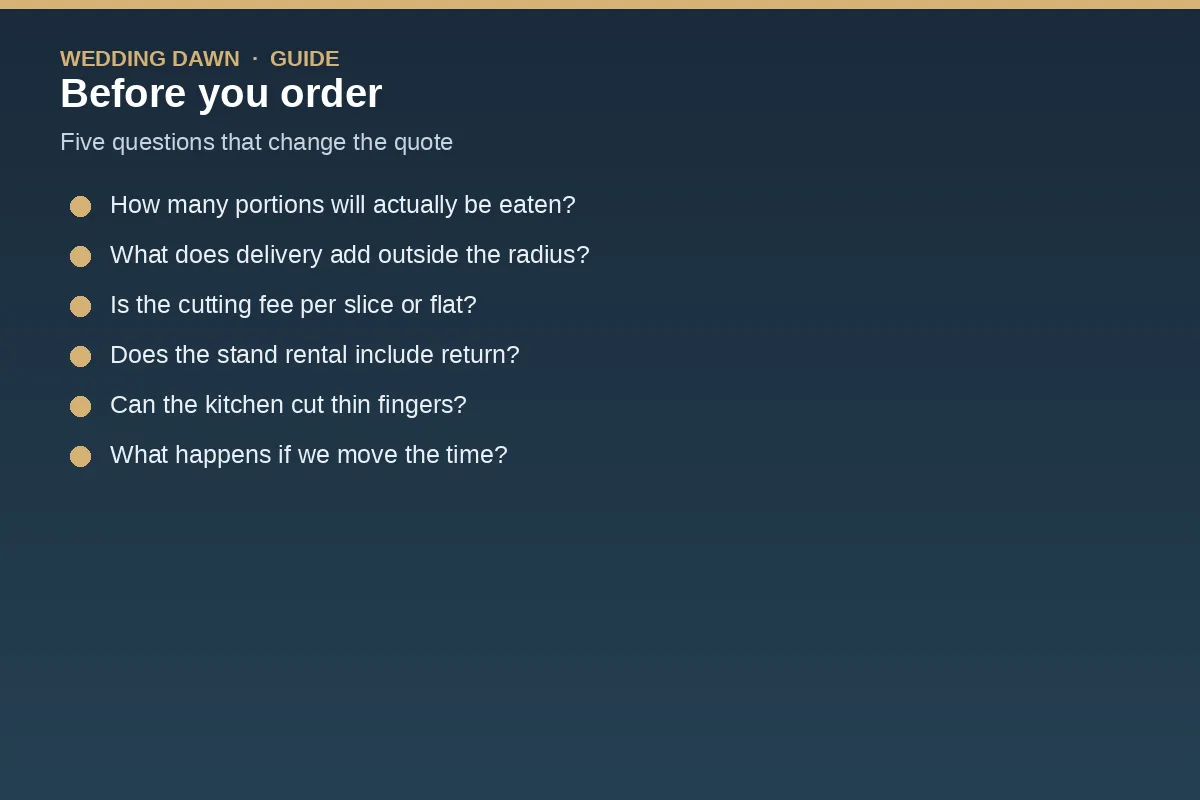
Bakers quote per slice, a unit that hides almost everything else. The slice price covers sponge, filling and icing. It does not cover delivery outside a radius, a weekend surcharge, the stand rental, plates and forks, the venue's cutting fee, service staff, or the 20 to 25 percent tax and gratuity that arrives at the end. A cake that looks like eight dollars a slice can land at twelve to fourteen dollars a slice by the time it is on the table.
- Base cake: roughly 6 to 12 dollars per slice in most US cities, higher for intricate work and premium flavours
- Delivery: 75 to 250 dollars, often free inside 10 miles and expensive beyond it
- Cutting and plating: 1 to 3 dollars per slice if the caterer handles it
- Stand, plates, forks and napkins: 40 to 150 dollars, or free if the venue supplies them
- Tax and service charge: 20 to 25 percent on top of everything above
- Waste and spares: plan 10 percent more than you think you need
Ask for a written quote that lists all six lines separately, and ask what happens if the delivery window moves by an hour. The number to compare is cost per served portion, not cost per slice on the baker's website. Two bakers quoting eight and ten dollars a slice can reverse order once delivery, cutting and the stand are included.
How many slices you need
Cake is served after dinner, when appetite is at its lowest point of the day. Ordering for every guest sounds generous and ends with half a cake in the venue fridge. The working rule is 75 to 80 percent of the guest count, less if there is a dessert table, more if cake is the only dessert. For 120 guests that is 90 to 96 portions. A 10-inch, 8-inch and 6-inch tier set gives roughly 90 to 100 slices depending on how the kitchen cuts them, and how they cut matters enormously. A caterer cutting one-inch fingers gets far more portions than one cutting fat wedges for the photograph.
- 6-inch round: 8 to 10 slices
- 8-inch round: 20 to 24 slices
- 10-inch round: 38 to 42 slices
- 12-inch round: 56 to 60 slices
- Three tiers (10/8/6): 70 to 76 dessert slices, 90 or more cut as thin fingers
If the numbers do not reach, do not add a tier. Add a kitchen sheet cake in the same flavour, cut and plated out of sight, at a fraction of the decorated price. A 12x18 sheet cake serves 40 to 50 and often costs less than a single decorated tier. Guests see the cake being cut; nobody sees where the rest of the slices came from.
Flavours that survive a long day
Buttercream tastes better than fondant and behaves worse. Above roughly 24 degrees Celsius, or in humid weather, buttercream softens, colors bleed and a tall tier can lean. Fondant holds its shape and photographs like a sculpture, but most guests peel it off. The practical compromise is a semi-naked or lightly iced cake for outdoor weddings, kept inside until 30 minutes before the cutting, and a fondant design only when the venue is air-conditioned and the cake stays indoors for the whole reception. If the cake is going outside in July, ask the baker what they would serve at their own wedding, not what they would photograph.
Fillings fail faster than sponge. Fresh berries and whipped cream weep within a couple of hours; lemon curd can make a tier slide; ganache and preserves hold. A naked cake looks wonderful in pictures and dries at the cut edges within an hour. If the cake will sit out through dinner, choose a buttercream finish, a ganache or preserve filling, and a flavour that does not depend on being cold. Carrot, almond, citrus and chocolate all hold up; delicate fruit flavours are better served from the kitchen.
Dessert table math
A dessert table is not automatically cheaper than a cake; it is priced differently. Caterers usually charge per piece, and guests take two or three. For 120 guests, plan 240 to 360 pieces across three or four formats, minus the cake portions you are already serving. Order 80 percent of that and let the last hour run out rather than throwing food away. Formats that survive a warm room include mini tarts, brownie bites, shortbread, macarons, doughnuts, churros and a cheese table. Formats that need power or a freezer are ice cream, mousse cups and anything with whipped cream.
- Three desserts plus cake: two pieces per guest, not three
- One showpiece station is a queue and a photograph; two compete with each other
- Coffee and tea service adds 2 to 4 dollars per guest and is remembered longer than the cake
- Stands and risers: 60 to 200 dollars in rentals, usually not included in per-piece quotes
Dietary needs, handled quietly
Every guest list contains someone who cannot eat the cake. The considerate solution is not a gluten-free tier that everyone shares, because cross-contamination in a home kitchen or a busy venue is real, but a small separate cake baked and boxed in the kitchen, labelled, and served by staff who know which is which. Order 8 to 12 portions for a wedding of 100 to 150; that covers coeliac guests, a few people avoiding gluten by preference, and the vegan cousin. Ask the baker whether they use a separate prep area and dedicated tins. Nut allergies deserve a straight answer about the whole menu, not just the cake: a dessert table with loose nuts, pralines or marzipan is a risk that labels do not remove.
- One small gluten-free cake, boxed and labelled, not a shared tier
- Vegan portions: 6 to 10, kept separate from buttercream
- Nut-free: ask about the entire dessert table, including decorations
- A written allergen list for staff, in plain language, not a binder of supplier spec sheets
Cutting logistics
The cutting photograph takes ninety seconds; serving the cake takes twenty minutes and usually happens in the kitchen. Decide in advance whether the ceremonial cut is real or symbolic. If it is symbolic, the venue cuts and plates in the back and the couple poses with a single slice. If it is real, someone has to hand out 90 slices, and that someone should not be the bride. Ask the caterer who cuts, when, and whether the fee covers plating and distribution. Confirm the announcement with the DJ or MC so people are not caught mid-conversation. And ask for boxes: most caterers will box what is left if you supply them, and 20 to 30 boxes means guests leave with cake instead of the venue bin filling up.
- Cut after the main course, before the first dance, about 90 minutes before the end
- Venue staff cut and plate; the couple cut one symbolic slice for photographs
- Provide 20 to 30 boxes if you want leftovers to leave with guests
- Confirm who returns the stand and by when; rentals are charged by the day
A timeline that avoids the last-minute call
- Six months out: shortlist three bakers, taste, book the date
- Four months out: choose tiers and design, confirm slice count and flavours
- Six weeks out: final headcount, dietary portions, delivery window
- Two weeks out: confirm venue access, insurance certificate, stand and cutting fee
- Three days out: final payment, delivery time, contact on the day
- Day of: keep the cake cool, cut at the agreed time, refrigerate leftovers within two hours
When to skip the cake
Some weddings are better without one. Destination weddings where the cake has to travel, venues that forbid outside food, and couples who genuinely do not like cake are all good reasons. The replacement should still give guests a moment and a dessert. A pie table, a cheese tower, a croquembouche, an ice cream cart or a stack of pancakes at a brunch wedding all work; each has its own logistics. A cheese tower for 120 costs roughly what a two-tier cake costs and doubles as cocktail hour food. An ice cream cart needs a power supply and a queue plan. Decide what the moment is for, then choose the object that does it, rather than defaulting to a cake nobody wants.
Leftovers and the top tier
Buttercream should not sit in a car overnight. Ask the caterer to box slices and refrigerate them within two hours; wrapped tightly, cake keeps three to four days in the fridge and two to three months in the freezer. Freeze individual slices on a tray first, then wrap; defrost in the fridge, not the microwave. The tradition of saving the top tier for the first anniversary works better if the baker freezes it properly and you do not move house twice in between. If the venue cannot store it, decide who takes it home before the night ends.
The cake is a small part of the budget and a large part of the photographs. Decide which job it is doing, count portions instead of tiers, and get every fee in writing. Then the only surprise on the day is how quickly the slices disappear.
Choose and serve a cake in five steps
Split the ceremonial cake from the dessert service
Decide whether the cake is mainly a photograph or mainly food, then budget a small decorated cake and a kitchen sheet cake if both matter.
Get a six-line written quote
Cake, delivery, cutting, stand and plates, tax and service, spares. Compare cost per served portion, not the per-slice headline.
Count portions, not tiers
Order 75 to 80 percent of the guest count, less with a dessert table; fill any gap with an undecorated kitchen cake.
Choose a finish for the room
Buttercream or semi-naked indoors, fondant only with air conditioning; pick ganache or preserve fillings that hold through dinner.
Write the cutting plan
Who cuts, at what time, who plates, who announces it and where the leftovers and the stand go before the night ends.
Cake and dessert checklist
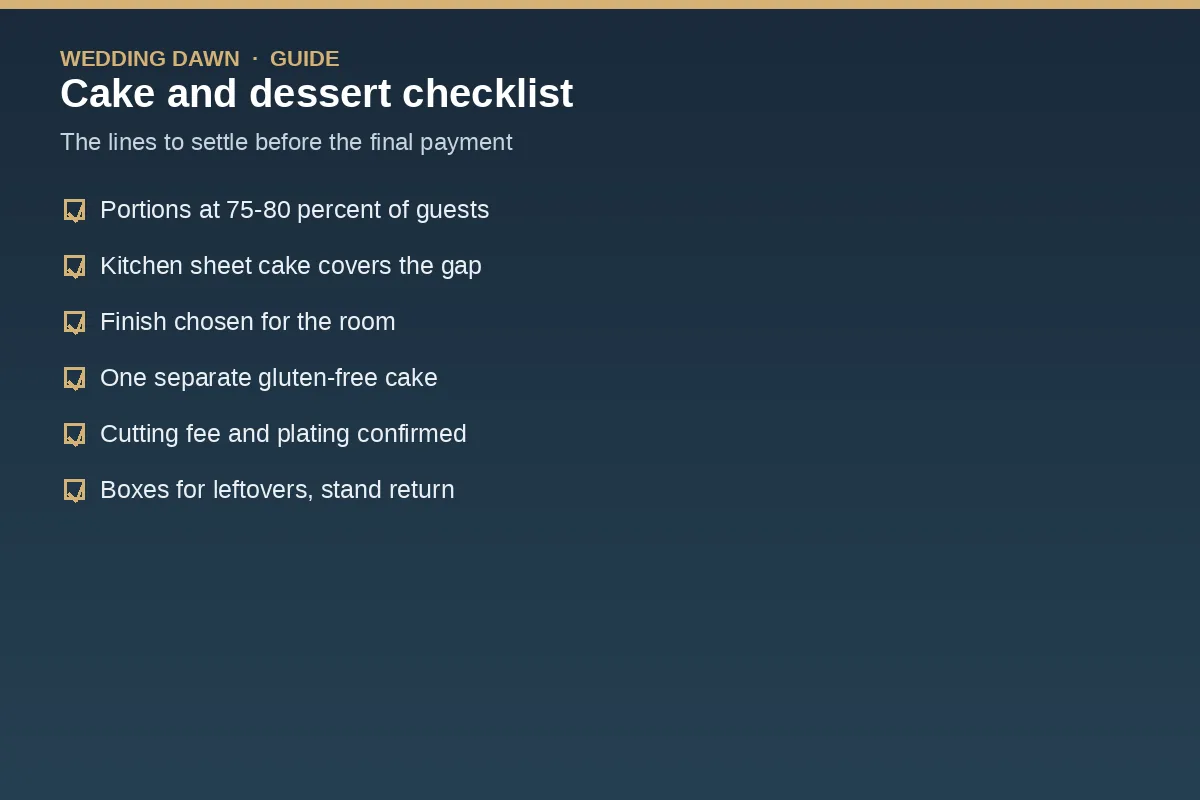
- Decided whether the cake is ceremony, dessert, or both
- Written quote lists cake, delivery, cutting, stand, tax and spares separately
- Portions ordered at 75 to 80 percent of guest count
- Kitchen sheet cake added if the decorated cake cannot cover everyone
- Finish chosen for the room: buttercream, semi-naked or fondant
- Filling holds through dinner: ganache, preserve, no fresh cream
- Gluten-free and vegan portions baked and boxed separately
- Allergen list written for staff in plain language
- Delivery window and venue access confirmed in writing
- Cutting fee and who plates confirmed with the caterer
- Announcement time agreed with the DJ or MC
- 20 to 30 boxes bought for leftovers
- Stand return and rental day confirmed
- Plan for refrigerating leftovers within two hours
Frequently asked questions
How much should we budget for a wedding cake?
Most couples spend 1 to 3 percent of the total budget. At 120 guests and 8 dollars a slice, the cake is about 960 dollars before delivery, cutting, stand and tax, which usually adds 30 to 40 percent. Ask for the six-line quote and compare cost per served portion.
How many slices do we need for 120 guests?
90 to 96 portions, which is 75 to 80 percent of the headcount. A 10, 8 and 6-inch tier set gives roughly 90 to 100 slices cut as dessert. If there is a dessert table, order less; if cake is the only dessert, keep the higher number.
Is a fake tier worth it?
Usually yes when the guest count is high. A decorated dummy tier costs 30 to 60 dollars and lets a two-tier cake look like three, while a kitchen sheet cake covers the portions at a fraction of the decorated price.
Can we serve cake that has sat out all evening?
Buttercream is safe for about two hours at room temperature, less in heat, and sponge dries at the cut edges within an hour. Keep the cake shaded and indoors until 30 minutes before cutting, and refrigerate leftovers within two hours.
What about gluten-free and vegan guests?
Order a small separate cake, 8 to 12 portions, baked and boxed in the kitchen and labelled. A shared gluten-free tier risks cross-contamination and rarely tastes good by the time it is served.
Do we have to save the top tier?
No. It is a tradition, not a rule. If you want it, ask the baker to freeze it properly; otherwise order a fresh small cake for the first anniversary and eat the leftovers this week.
See all frequently asked questions →
Sources
- The Knot — Wedding cake planning and serving guide Tier serving charts, typical per-slice ranges and cutting-fee practice; checked 2026-11.
- USDA FSIS — Leftovers and food safety Two-hour refrigeration rule and freezer storage guidance used in the leftovers section; checked 2026-11.
- FDA — Food allergies Allergen handling and cross-contamination guidance for the dietary section; checked 2026-11.