Small Wedding Planning: 20-50 Guests
A small wedding is not a scaled-down big wedding. At thirty guests the arithmetic changes: the photographer, the band and the room each cost close to what they would cost for a hundred and fifty, so the price per guest climbs even as the total falls. Couples who enjoy the format most are the ones who stop trying to reproduce a large wedding and instead design an evening that only works in a small room.
The order of decisions matters. Guest list first, because it sets the room. Budget second, because fixed costs dominate at this size. Venue third, because restaurants price differently from event halls. Then the run of show and the roles. Get those four right and the rest is decoration.
Start with the list, not the mood board
Write three columns: people you would call at midnight, people you would be sad to see missing from the photographs, and people who would be hurt not to be invited. Only the first two columns belong on the list. Thirty guests is really fifteen couples, and every addition changes the seating, the room and sometimes the venue.
Tell the wider circle before the news travels. A short personal call explaining that you are keeping it tiny, and that it is about the format rather than about them, prevents most of the damage. Then plan a separate low-key gathering afterwards: drinks, a barbecue, a Sunday lunch. Two small events usually cost less than one medium one and leave fewer hurt feelings.
Price the fixed costs first
Build the budget in two columns: fixed and per head. Fixed covers photography, music, attire, flowers, stationery, the officiant and any room fee. Per head covers food, drink, rentals and favors. At a hundred and fifty guests, catering dominates. At thirty, fixed costs are often two thirds of the total, which is why trimming the list stops saving money after a point.
That has a practical consequence: negotiate the fixed items hardest. Ask photographers about half-day or elopement rates, ask a florist for ceremony-only work, and ask whether a duo or a DJ suits the room better than a band. Vendor minimums are real, and many photographers will not book a four-hour Saturday below a full-day rate, so compare quotes at your actual hours rather than at the advertised package.
Choose a room that is already the right size
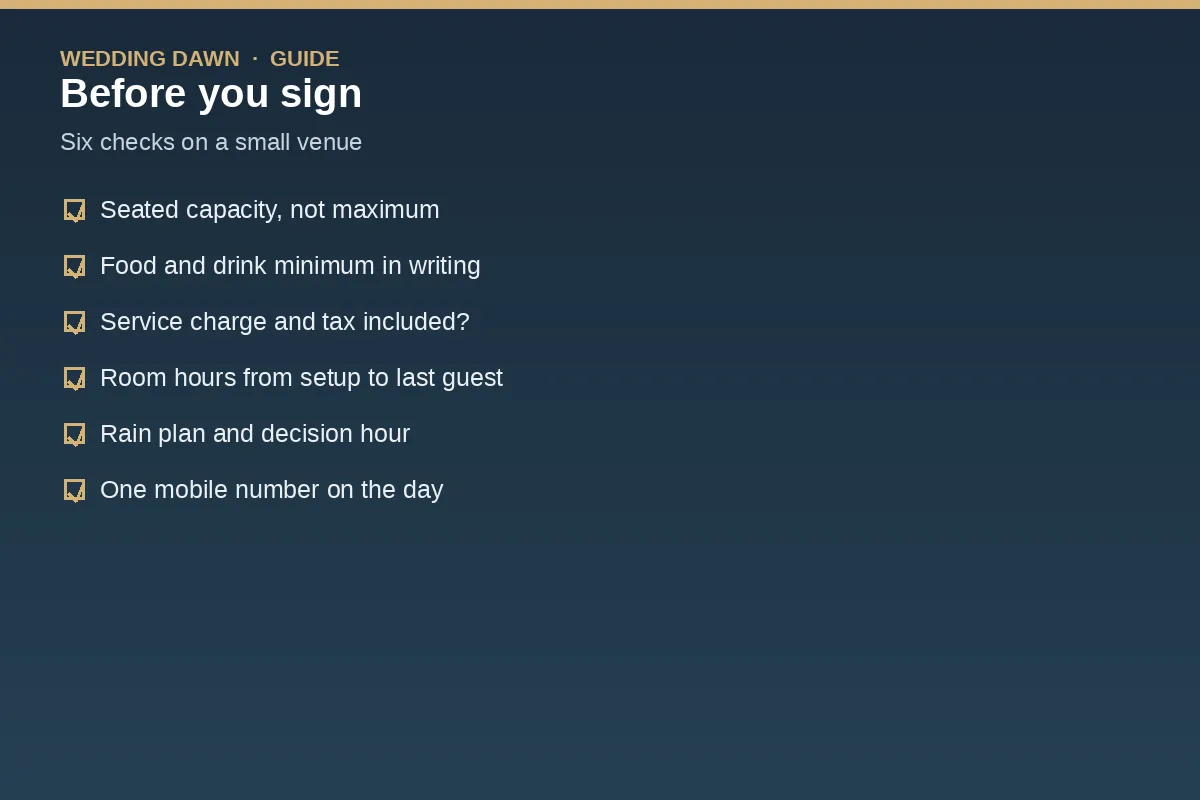
The biggest quality difference between a good small wedding and a cramped one is whether the room fits. Forty people in a hall built for two hundred feels like a rehearsal; forty in a restaurant private room feels like a party. Ask every venue for its comfortable seated capacity, not its maximum, and ask what else is booked in the building that night.
Restaurants and private dining rooms
A buyout or private room usually includes tables, chairs, glassware, staff, kitchen and bathrooms, which removes most of the rental line items. The trade is a food and beverage minimum instead of a rental fee. Ask what counts toward the minimum, whether service charge and tax are included, how long the room is yours, and what happens if five guests drop out.
Watch the timing. A restaurant that turns the room at nine in the evening is not a wedding venue unless you pay for the second seating too. Get the room from setup to last guest in writing, and confirm whether the bar or terrace stays open to the public during your event.
Gardens, galleries and studios
Non-traditional spaces look cheap on paper and often cost the difference back in rentals, power, bathrooms and insurance. Before signing, ask who carries liability cover, what the rain plan is, when the crew can load in, and whether a landlord or neighbors impose a curfew. A white gallery with good light needs almost no decoration, which is its own saving.
Design a four-hour evening, not a six-hour day
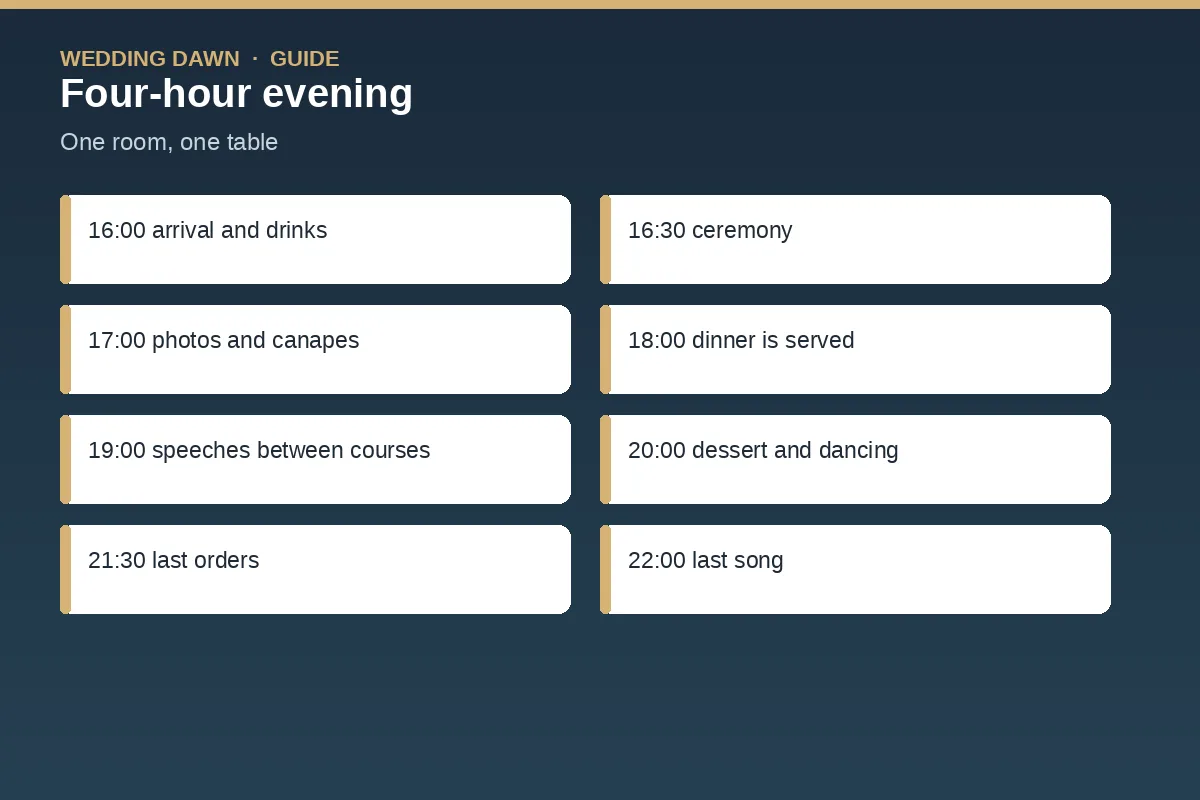
Small weddings run on a shorter clock and feel better for it. A workable shape: arrival at four, ceremony at half past, drinks and photographs for an hour, dinner at six, speeches between courses, dessert and dancing by eight, last song at ten. No gap, no second location, no long wait for the couple to come back from portraits, because everyone is in the same room.
The schedule can flex because the group is small. A thirty-person dinner tolerates a late start that a hundred-person reception cannot, and one long table produces one conversation instead of eight. Use that: seat people who should meet next to each other, split couples on purpose, and skip the receiving line.
One long table is usually the strongest layout for twenty to forty guests. Allow about two and a half feet of table per person plus serving space behind the chairs, and check that the room has a straight path to the kitchen. Round tables of eight work better above forty, when a single table becomes too long to talk across.
Food, drink and what guests actually remember
A set menu beats a buffet at this size. Three courses with two choices each, chosen in advance, keep the kitchen calm and the table served together. Ask for a vegetarian main that is not an afterthought, note allergies on the seating plan, and confirm whether children are charged as adults.
The bar is where small budgets quietly blow up. A short list of two cocktails, beer, wine and soft drinks, served by staff, is cheaper and faster than a self-serve open bar. Estimate two drinks per guest in the first hour and one per hour after, and stop service half an hour before the end. If you bring your own alcohol, check corkage and licensing first.
Spend on what a small room magnifies: good glassware, warm light, flowers at eye level, and a photographer who works well close in. Skip what nobody notices at thirty guests: a large cake, a grand entrance, a photo booth, and printed programs for a ceremony that lasts twenty minutes.
Roles, payments and the day itself
Assign three jobs in writing: who holds the timeline, who holds the payments and tips, and who handles family logistics. Two people can cover them, but neither should be the couple. Give the venue one mobile number that will actually be answered on the day, and tell the photographer who that person is.
Final payments and tips are the most common day-of surprise. Prepare envelopes in advance, mark who has already paid by card, and keep a printed list instead of trusting a phone. Confirm with the photographer and the musician when the balance is due, since small bookings often mean a deposit plus a payment on the day.
Photography deserves its own conversation. With thirty guests, three or four hours covers the ceremony, the portraits and the room, so ask for a partial-day rate and be explicit about the group shots you want. Hand over a list of names; in a small group nobody wants to spend twenty minutes rounding people up.
Where small weddings go wrong
The failures are predictable. Filling a room with guests you do not really want there. Choosing a space whose minimum spend forces a bigger party than planned. Cramming a bouquet toss, a first dance, four speeches, a three-course meal and dancing into four hours. Forgetting that a small group notices everything, including a cold main course and a host who never sits down.
- Confirmed seated capacity in writing, not the venue maximum
- Food and beverage minimum, service charge and tax spelled out
- Room access time for setup and a hard end time for load-out
- Rain plan with a named decision hour and a decision maker
- Menu tasted, dietary needs collected, children priced
- Musician or DJ briefed on room size and speech timing
- Photographer booked for the real number of hours
- One mobile number the venue can call on the day
- Cash envelopes prepared and a printed payment list
- Transport home arranged for the last ten guests
A small wedding is a dinner party with a ceremony attached, and it should be planned like one: a guest list you can defend, a room that fits, a menu you have tasted, and a schedule with room to breathe. Do that and the format stops feeling like a compromise and starts feeling like the reason the day was good.
Step by step
Fix the list at a number
Decide the headcount before touring anything, and write down the three people you would cut first if the room demands it.
Split the budget into fixed and per head
See what share is fixed; if it is over half, negotiate photography, music and flowers rather than trimming guests further.
Tour rooms at your real size
Ask for comfortable seated capacity and a sample layout for your exact count, not the venue maximum.
Sign only with the minimum spelled out
Get the food and beverage minimum, service charge, room hours and cancellation terms in writing before paying a deposit.
Write a four-hour run of show
One room, one table, speeches between courses, and a named person holding the timeline on the day.
Quick checklist
- Confirmed seated capacity in writing, not the venue maximum
- Food and beverage minimum, service charge and tax spelled out
- Room access time for setup and a hard end time for load-out
- Rain plan with a named decision hour and a decision maker
- Menu tasted, dietary needs collected, children priced
- Musician or DJ briefed on room size and speech timing
- Photographer booked for the real number of hours
- One mobile number the venue can call on the day
- Cash envelopes prepared and a printed payment list
- Transport home arranged for the last ten guests
- Guest list told personally before the news spreads
- A separate low-key gathering planned for everyone else
FAQ
How many guests counts as a small wedding?
Most planners treat anything under about fifty guests as small, and under twenty as a micro wedding. The useful threshold is logistical: once you need a tent, a restroom trailer and a shuttle, you are running a large event in a small venue.
Is a restaurant cheaper than a wedding venue?
Often, because tables, chairs, glassware, staff and bathrooms are already there. Compare the total of the food and beverage minimum plus service charge against the venue fee plus every rental you would otherwise need, at your real guest count.
How do I keep the list small without offending people?
Tell people personally before they hear it elsewhere, frame it as a format choice rather than a judgment, and offer a separate casual gathering. Being clear early is kinder than a late invitation or a rumour.
Do we need a DJ or a band for thirty guests?
Neither is mandatory. A good playlist through the venue sound system works for dinner; a DJ or duo adds most value once there is dancing. Brief whoever plays on the room size and where speeches happen.
Can a small wedding still have dancing?
Yes, if you leave floor space and time. Ten by twelve feet is enough for twenty dancers, and placing it between dinner and dessert keeps people in the room instead of drifting to the bar.
How many hours should we book the photographer?
Three to four hours covers a ceremony, group portraits and the room for thirty guests. Ask for a partial-day rate and give a shot list, since a small booking usually means fewer hours but the same editing work.
Sources
- The Knot — Real Weddings Study Guest-count and budget benchmarks used for the fixed vs per-head comparison, checked 2026-11.
- Zola — Wedding guest list etiquette Guidance on trimming a guest list and telling people who are not invited, checked 2026-11.
- USDA FSIS — Cooking for Groups Food holding temperatures and the two-hour rule for set menus and buffets, checked 2026-11.