Second Wedding Etiquette: What Changes
A second wedding does not need an apology, a smaller version of the first one, or a ceremony built around what other people might think. It needs a clear decision about what this marriage is, and a plan that matches it. The couple who eloped the first time often wants the family party now; the couple who had the big wedding often wants a quiet afternoon. Both are legitimate. The mistake is assuming the second wedding should follow the same script as the first, only with different names on the invitation.
What actually changes is not the depth of the commitment. It is the context around it: children who are part of the household, families who have already been through one wedding, guest lists that include former in-laws, and a social script that still carries outdated assumptions. This guide covers the decisions that come up most often, with wording for the awkward parts and a structure you can adapt rather than copy.
Start with what this wedding is for
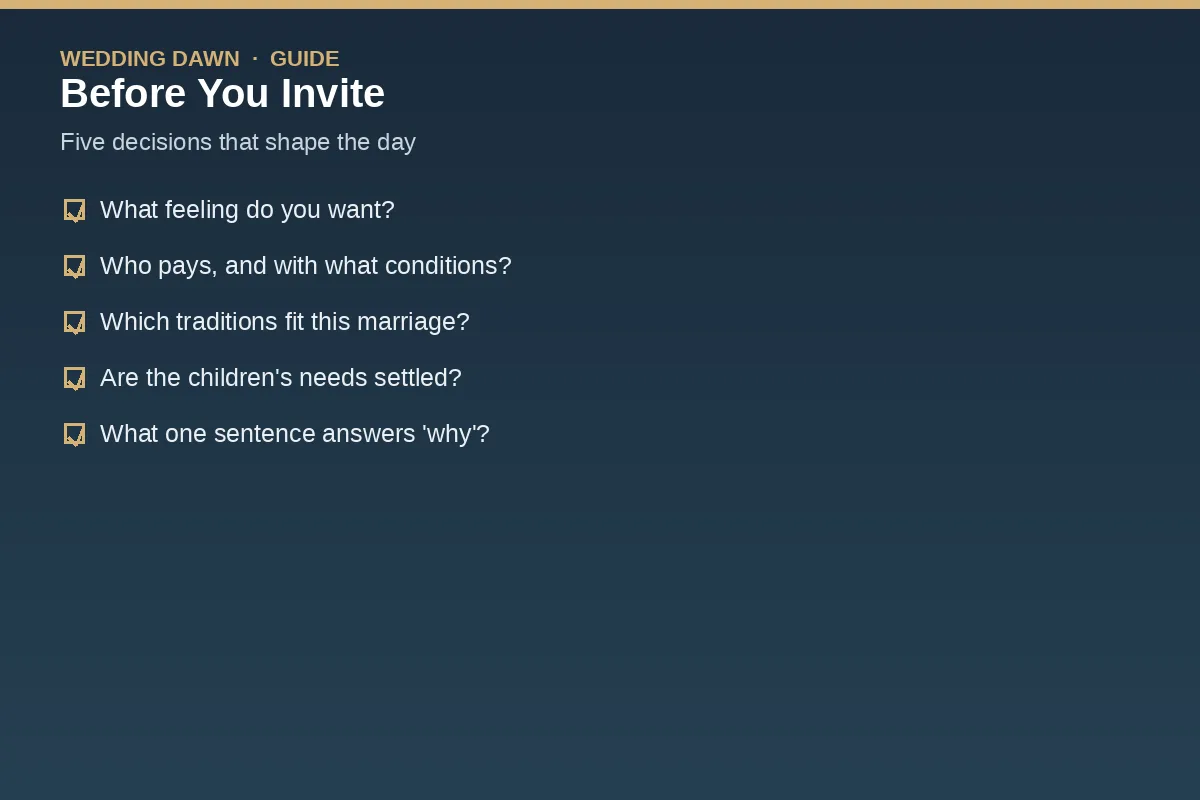
Before the venue or the guest list, answer one question: what do you want people to feel? A second wedding is often more deliberate than the first, because you know what you actually use and what you merely endured. That usually means fewer traditions, a shorter ceremony, and a reception that feels like a good dinner rather than a performance. It can also mean a bigger celebration, especially if the first was small or if children are now part of the story.
Write down three things you want and three you are happy to skip. Then check the list against who is paying and who has expectations. The conversation is easier when it starts with a positive decision rather than a defense: 'We want a small ceremony with our children, then dinner with forty people' is easier to support than 'we don't want a big thing'.
- Decide the feeling first, the format second.
- Name three traditions you want and three you will skip.
- Agree who is paying before the venue shortlist.
- Check legal requirements for a second marriage locally.
The guest list is the hard part
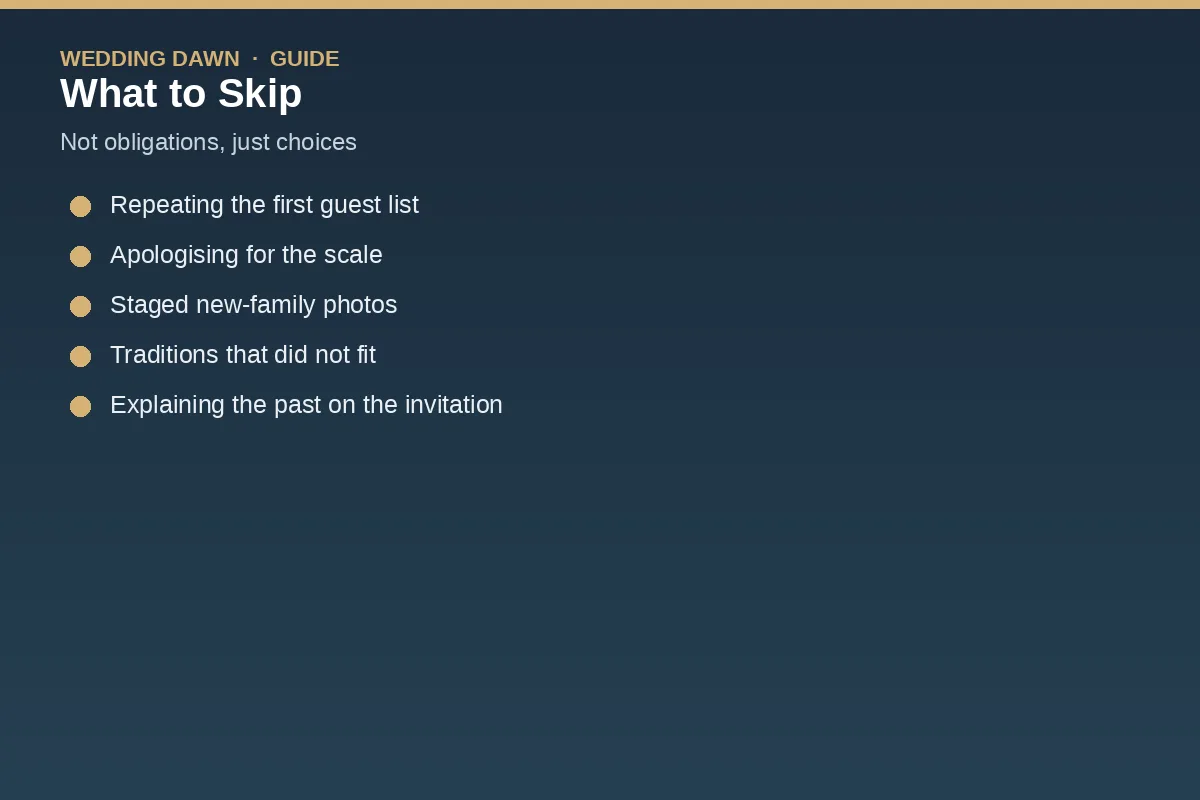
Second weddings tend to have three overlapping lists: your people, your partner's people, and the people who were at the first wedding. The last group needs care. Invite the friends who stayed, and do not feel obliged to invite everyone who attended before. If a former in-law is still close to your children, they may belong on the list for reasons that have nothing to do with your ex. Decide by relationship, not by obligation.
Children change the arithmetic. If either of you has children, their other parent may need to be informed about the date, especially for custody and travel. Invite the children's grandparents if they are part of their lives, and seat them where they can see the ceremony without being pulled into photographs they did not agree to. A seating plan that ignores these relationships creates problems that outlast the cake.
- Invite by current relationship, not by old obligation.
- Do not re-invite the whole first-wedding guest list by default.
- Keep former in-laws only where a real relationship exists.
- Tell the children's other parent the date early.
- Seat blended-family grandparents thoughtfully.
Invitations, showers, and gifts
Invitation wording can be simple: 'Together with our families, we invite you to celebrate our marriage.' You do not owe guests an explanation of the first marriage, and you do not need to call it a 'second wedding' on the card. If the ceremony is small, say so. If gifts are not expected, say that too, in one line, and mean it.
Gift etiquette varies by region and family. In many places a shower is not customary for a second wedding, especially when the couple already has a household; in others nobody minds. The safer approach is to let a close friend or relative answer questions, and to skip the registry if you do not need anything. If you do register, keep it short and focused on what is genuinely useful. A note such as 'Your presence is the gift; if you would like to contribute to our honeymoon fund, here is the link' is clear and does not pressure anyone.
- Use neutral invitation wording; no explanation owed.
- State the scale plainly: small ceremony, dinner, or party.
- Skip the registry if you already have a household.
- Let a relative handle shower questions.
- If you mention gifts, give one clear alternative.
Children, vows, and roles
If children are part of the marriage, give them a role that is real rather than decorative. A short vow to the children, a reading, carrying the rings, or simply standing with you can matter more than a title. Ask them what they want to do, and accept a no. Do not stage a 'new family' photograph if a child is uncomfortable; the picture will remind everyone of the discomfort, not the joy.
Vows can be new or familiar. Some couples write fresh promises that acknowledge what they learned; others use the same words as a deliberate continuity. Both work. What does not work is a ceremony that pretends the past did not happen while the children, the guests, and the photo albums all remember it. A single sentence of acknowledgement, spoken or printed in the program, is often enough.
- Give children a real role, and let them decline.
- Ask what they want, separately from what looks good.
- Write vows that fit this marriage, not a template.
- Acknowledge the blended family without turning it into a lecture.
The ceremony, without re-enacting the first
You do not need to repeat the traditions that did not fit the first time. A short ceremony with one reading, one vow exchange, and a clear officiant works. If you want a friend to officiate, check the local legal requirements first, because the rules differ and a ceremony that is not legally valid creates a different set of problems. If you want a religious ceremony, talk to the officiant about how a previous marriage is handled; most have a clear process and prefer to discuss it early.
Think about the moments that carry weight: who walks you in, who stands beside you, whether anyone gives you away. These are choices, not obligations. A couple who walks in together, or who has their children beside them, is not breaking a rule; they are writing a ceremony that matches the family they are making.
- Check the legal requirements for the officiant and the license.
- Choose the processional that fits, not the one that is expected.
- One reading and one vow exchange is a complete ceremony.
- Ask the officiant how the previous marriage will be referenced.
Managing family expectations
Parents, siblings, and close friends may have opinions shaped by the first wedding, including grief about it. Do not try to win the argument. Give them a specific job, thank them for it, and keep the decisions with the couple. If a family member offers money with conditions, clarify the conditions before accepting: a contribution that comes with a guest list is not a gift, it is a negotiation.
There will also be people who expect an explanation. You can give one sentence and move on: 'This is a different marriage and a different day.' You do not need to justify the size, the absence of a veil, or the fact that you are wearing color. A second wedding is not a correction of the first; it is a separate event with its own logic.
- Give willing family a specific task instead of a debate.
- Clarify conditions before accepting money.
- Keep one sentence ready for people who ask why.
- Do not justify the dress code, the size, or the absence of traditions.
Step by step
Decide the purpose
Name the feeling and the scale before booking anything.
Build the guest list by relationship
Include children and the people who stayed; leave old obligations off.
Choose the wording
Neutral invitation, plain scale, no explanation of the past.
Design roles for children
Ask what they want; accept a no; skip staged family photos.
Handle family and money early
Clarify conditions, assign tasks, keep decisions with the couple.
Quick checklist
- Purpose and scale written down.
- Budget and who contributes agreed.
- Legal requirements checked, including any previous-marriage paperwork.
- Guest list built by current relationship.
- Children's other parent informed early.
- Invitation wording neutral and clear.
- Gift position decided and stated once.
- Officiant and ceremony length agreed.
- Roles for children optional, not assigned.
- Plan for family questions and offers of money.
FAQ
Is it tacky to have a big second wedding?
No. Scale is a budget and preference decision, not an etiquette violation. What matters is that guests are hosted well and that the couple is clear about what the day is.
Should we invite people who came to the first wedding?
Invite the ones you still have a real relationship with. There is no rule that the first guest list must be repeated, and no obligation to explain the omissions.
Do we need to mention the first marriage on the invitation?
No. Neutral wording such as 'together with our families' is enough. Your guests do not need a history, and the invitation is not the place for one.
How do we include children without making them perform?
Ask them what they would like to do and accept a no. A reading, rings, or standing with you is enough. Skip staged family photos if a child is uncomfortable.
Should we register for gifts?
Only if you need something. Many second-wedding couples already have a household and say so in one line. If you prefer a honeymoon fund or charity, state it clearly and once.
Sources
- Emily Post Institute — Etiquette advice Guest consideration and invitation wording, reviewed 2026-11.
- USA.gov — Marriage licenses Local license and officiant requirements, reviewed 2026-11.
- NIST — Privacy Framework Handling children's and guests' personal information, reviewed 2026-11.