Destination Wedding Planning: A Realistic Guide
A destination wedding is a travel project with a ceremony attached. That sentence sounds unromantic until the fourth spreadsheet revision, when the couple realizes that the flights, the rooms, the transfers and the three-day schedule are what actually decide whether the week feels generous or exhausting. Couples who enjoy theirs are rarely the ones who found the most photogenic cliff. They are the ones who treated the trip as the product and the ceremony as its centerpiece.
Almost every cost overrun starts before a single booking is made: a venue is chosen from photographs, then the guest list is built around it, then the budget is bent to fit. Reverse that order. The place should be the last major decision, not the first, because the place is the only line item that cannot be negotiated down once it is signed.
Start with the trip, not the venue
Three questions settle more than any mood board. Who absolutely must be in the room? How many days can those people realistically take off work and away from children or carers? And what is the plan if a flight is canceled, a border closes or a storm shuts the airport for two days? Write the answers down. They will eliminate half the map without any argument.
Choose a region before a venue, because regions set flight prices, visa timelines and the range of hotel options. A beautiful villa with one expensive flight and no mid-range hotels turns into a week that only six of your guests can afford. A good region has several price points for sleeping, eating and getting around, so guests can join at the level that suits them.
The guest list is a travel list
Send a save-the-date nine to twelve months ahead, and include an honest cost estimate for flights and lodging rather than a vague promise that it will be affordable. People plan annual leave in January; if they learn about a November wedding in August, they will not come, and they will be right not to. Ask for a firm yes or no earlier than you would for a local wedding, because room blocks and deposits depend on it.
Expect a lower acceptance rate than you would at home, and do not read it as a verdict on the friendship. A destination wedding effectively asks guests for three days, a flight and several hundred in cash. Some of the people who love you most cannot spend that, and a wedding that makes them feel guilty is not a warmer wedding.
Pick a season you can defend
Shoulder season is usually the honest answer: cheaper flights, available venues, weather that is merely warm rather than punishing. Check the rainy season, the hurricane season and the local holiday calendar for the specific region, not for the country as a whole; a coastal state and a mountain state in the same country can have opposite seasons. If the date falls inside a risk window, write the backup plan into the contract before you sign it.
Build the budget in three columns
Split the money into flights, lodging and the event. The event is the only column you control after the destination is fixed, and it is usually the smallest of the three. A couple spending forty thousand on a week abroad might spend ten on the ceremony and thirty on getting everyone there and keeping them fed. That is not a failure of priorities; it is what a destination wedding is.
What people forget to price
- Airport transfers for the whole group, including the late arrival
- Welcome dinner and the morning-after brunch, which guests treat as part of the wedding
- Local permits, translations, apostilles and courier fees for documents
- Vendor travel, accommodation and per-diem for photographers or musicians brought from home
- Travel insurance that covers the event, not only the flight
- A 10 to 15 percent contingency held in cash, not in a credit limit
Build the contingency before the guest list is final. Destination weddings attract small, boring disasters: a lost suitcase with the rings, a closed road, a celebrant with the wrong date in the diary. Ten percent is not pessimism; it is the difference between solving a problem quietly and spending the reception explaining it.

Legal requirements, before you fall in love with a venue
Marriage law is local, and it changes. Residency requirements, waiting periods, blood tests, witness rules and the documents that must be translated and apostilled vary not only between countries but sometimes between regions of the same country. A ceremony that is legally binding in one place may be purely symbolic in another, and the difference is discovered at the registry office, usually by email, usually late.
There are two clean routes. The first is to marry legally at home, quietly, and hold a symbolic ceremony abroad; this is far simpler and is what many couples actually do. The second is to marry legally abroad, which needs a local planner or lawyer who handles the paperwork as a service, a longer lead time, and a willingness to accept that the process is not designed around your schedule. Decide which route you are on in writing before you book anything, because the answer changes the date, the documents and sometimes the guest list.
Check passports first. Most countries require six months of validity beyond the date of travel, and some require blank pages. Order apostilled birth certificates and any prior-decree documents early, since translation and courier time is measured in weeks. If either of you has been married before, the paperwork is not a detail; it is often the critical path of the whole project.
Choose a venue that survives weather and logistics
Ask every venue four questions in writing: what is the rain backup, is it the same size and standard as the outdoor space, how long is the transfer from the main hotel cluster, and who decides to move the ceremony inside. A rain plan that consists of a smaller room and a shrug is not a plan. Neither is a backup that requires a forty-minute bus ride while guests are already dressed.
The twenty-minute rule
Guests should be able to reach the ceremony from their beds in about twenty minutes. Longer than that and the day acquires a commute, which is the single most reliable way to make a destination wedding feel like a conference. If the venue is remote, run shuttles on a fixed timetable and tell people the times twice: once in the invitation and once on the day.
Food, water and altitude
Ask the caterer how they handle dietary requirements and how they keep food at temperature outdoors. In hot climates, avoid anything that has sat in the sun, and provide more water than feels necessary. If the venue is at altitude, plan a gentler first evening: alcohol hits harder, sleep is lighter, and a couple who schedule a late welcome party the night after a long flight will pay for it on the wedding day.
Vendors: contract in the local language and yours
Every contract should exist in a version you can read, with the deposit, the cancellation terms, the force majeure clause and the delivery date for photographs written plainly. Ask who owns the images, how long the gallery stays online, and what happens if the photographer's equipment is stolen. Pay deposits by a method with a paper trail, and never by cash to a person who is not the contracting party.
Hiring a local planner for at least the permit and setup day is usually worth more than upgrading the flowers. The planner knows which officiant answers email, which rental company actually delivers on time, and which beach requires a permit that nobody mentions on the website. If you bring vendors from home, budget their flights, room and per diem openly; a photographer working abroad for four days is not charging the same as one working a Saturday afternoon.
A three-day run of show
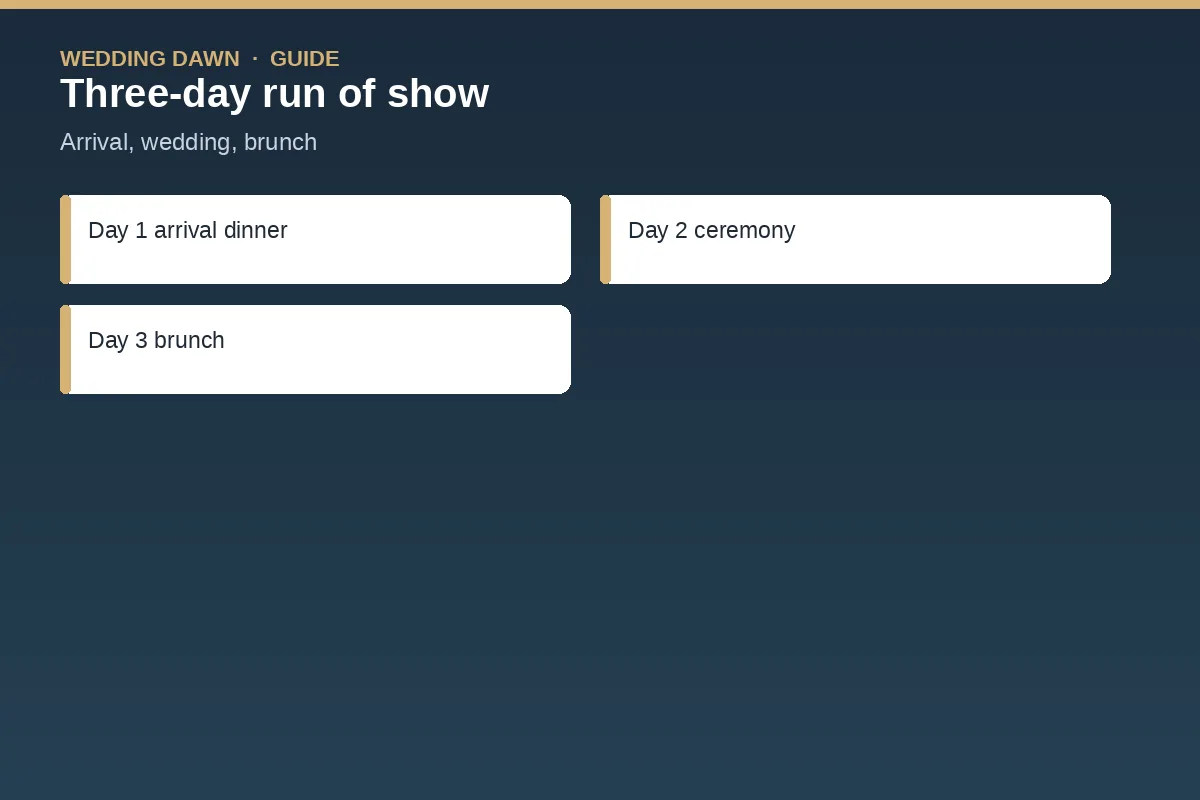
Treat the wedding as three days. Day one is arrival: a loose evening, no speeches, food that can be eaten standing up, and an early finish. Day two is the wedding: ceremony, photographs, dinner, dancing, and a hard stop that the couple can leave before. Day three is a brunch, ideally within walking distance of the hotels, which is where the best conversations of the week usually happen.
Print a single page with the times, the addresses, the dress code for each event and a phone number that works locally. Put it in the welcome bag and send it as a PDF two weeks before. Guests who have the schedule ask fewer questions, arrive on time and forgive small delays, because they can see what is supposed to happen next.
Documents, money and phones
Scan passports, the marriage paperwork, insurance policies and the venue contract into a folder that both partners can open offline. Carry two payment cards from different networks and enough local cash for a taxi and a meal. Tell your bank you are traveling, and check that your phone plan works abroad or buy an eSIM before you fly; the person who cannot call the shuttle driver is always the one holding the schedule.
Travel insurance should cover cancellation of the event itself, not just the flight, and should be bought when the first non-refundable deposit is paid. Read the exclusion for pre-existing medical conditions and for named storms. It is a dull paragraph that decides whether a bad week becomes a financial year.
What to skip
Skip the welcome gifts that have to be carried home. Skip a second outfit change unless it is genuinely part of the plan. Skip the sixty-person rehearsal dinner that turns into a second wedding. Skip elaborate signage that nobody reads after the first ten minutes. Spend the money on transport that works, food that is served hot and a photographer who is not rushed, because those three are what guests remember when the flowers have been forgotten.
The honest test
Ask whether the trip would still be a good week if the ceremony were canceled. If the answer is yes, the destination is right: people will have swum, eaten well and seen each other, and the wedding becomes the reason rather than the entire product. If the answer is no, the wedding is carrying a holiday that it cannot hold, and the kinder move is to choose a closer place or a smaller trip.
None of this makes a destination wedding cold or transactional. It makes it honest. The romance is in the swim before breakfast, the long table under a tree and the friend who flew eight hours and is still laughing at dinner. Those things happen more reliably when the paperwork, the transfers and the contingency are already settled.
Step by step
Fix the dates and the headcount first
Agree on a three-day window and a firm guest number before you look at a single venue, because both decide which places are even possible.
Price the trip before the ceremony
Build a real per-guest estimate for flights and lodging, then set the event budget from what is left rather than from what a venue quotes.
Confirm the legal route in writing
Decide between a legal ceremony at home and a legal ceremony abroad, then list the documents, translations and apostilles each route needs.
Book venue and room block in the same week
A venue without beds nearby is a problem, and a room block without a confirmed date is a guess; negotiate them together.
Write the three-day schedule and share it twice
Print one page with times, addresses and dress codes, send it two weeks ahead, and put a copy in every welcome bag.
Quick checklist
- Passports valid for at least six months beyond travel
- Legal route chosen and confirmed in writing
- Apostilled birth certificates and any divorce decrees ordered early
- Guest cost estimate sent with the save-the-date
- Venue rain plan of equal size and standard, in writing
- Transfer time from the main hotel cluster measured, not guessed
- Room block with a release date and a clear deposit rule
- Vendor contracts readable in your own language
- Photographer delivery date, image rights and backup plan stated
- Travel insurance bought when the first non-refundable deposit is paid
- 10-15 percent contingency held in cash
- One-page three-day schedule printed and sent as a PDF
FAQ
How far ahead should we plan a destination wedding?
Twelve months is comfortable for most international weddings, and nine is workable. Anything under six months is possible but narrows the venue list and raises flight prices; paperwork alone can take eight to twelve weeks.
How much should we budget per guest?
Rather than a single number, budget the trip and the event separately. Guests usually pay their own flights and rooms; the couple covers the ceremony, dinner and transport. Add a 10-15 percent contingency, because currency and transfer costs move.
Do we need a local wedding planner?
Not for the whole event, but almost always for permits, setup and the legal paperwork. A planner who lives there knows which officiant replies, which rental company delivers on time and which beach needs a permit.
Can guests book their own hotels?
Yes, and many prefer it. Give a recommended cluster and a room block with a release date, plus a clear note that booking outside the block means arranging their own transfers.
Is it rude to ask guests to pay for their own trip?
No, as long as you are explicit early. What feels rude is a vague save-the-date followed by a large number later. State the realistic cost, offer a cheaper option and accept a no without pressure.
What if the country requires residency before marriage?
Then a legal ceremony there may be impossible on a short trip. Most couples in that situation marry legally at home and hold a symbolic ceremony abroad, or choose a country with a shorter residency requirement.
Sources
- U.S. Department of State — Marriage abroad Country-by-country document and residency requirements; checked 2026-11.
- GOV.UK — Getting married abroad Apostille, translation and local registration guidance used for the legal-route section; checked 2026-11.
- The Knot — Real Weddings Study Guest-count and cost benchmarks behind the three-column budget; checked 2026-11.