Blended Family Wedding: Including Kids
A blended-family wedding is not a wedding with children added at the end of the guest list. The children are already part of the household, and the ceremony is one of the few public moments where that fact can be acknowledged properly. Done well, it gives them a place in the story without asking them to perform a version of happiness they may not feel. Done badly, it turns them into props in a photograph they did not agree to.
This guide is about the decisions that actually shape the day: what to ask the children, which roles are real and which are decorative, how to write a family vow without making a child promise something no child should promise, how to seat two families that share a history, and how to get through the logistics of two households on one schedule. It assumes goodwill and acknowledges that goodwill is not the same as agreement.
Talk to the children before you plan
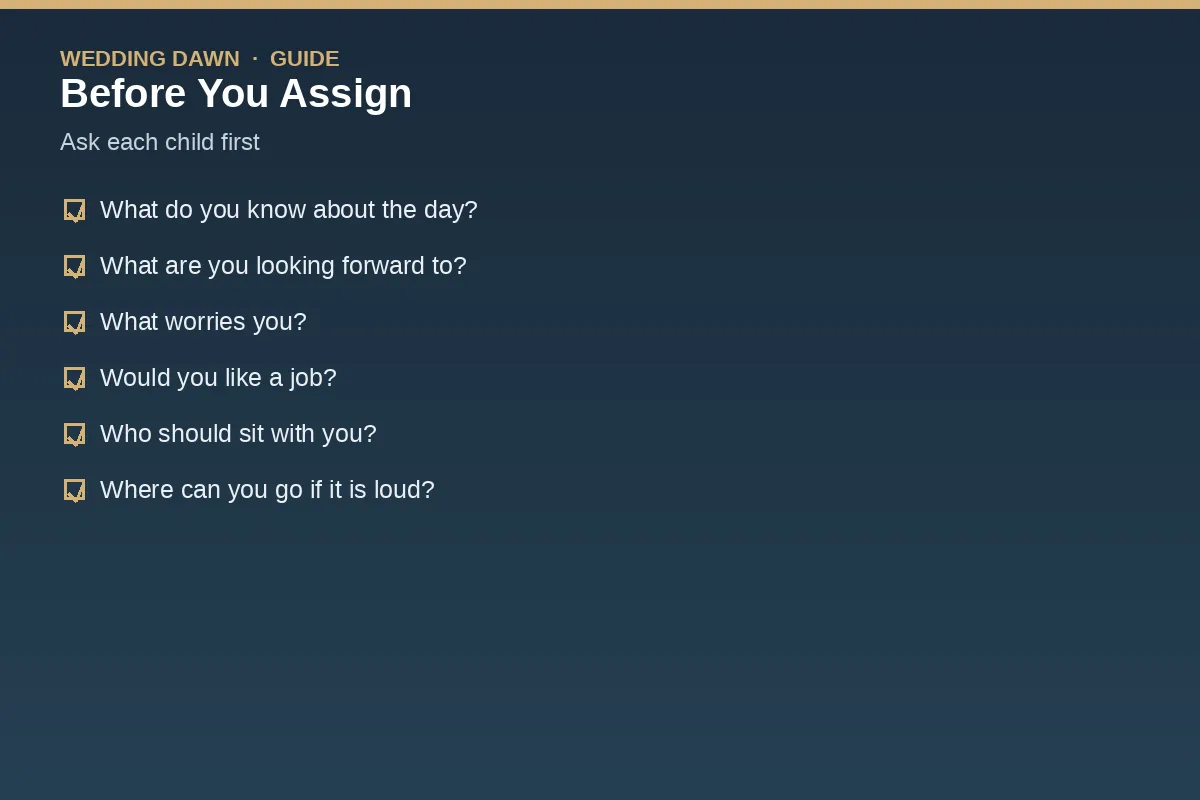
Start with a conversation, not an announcement. Ask each child what they know about the wedding, what they are looking forward to, and what they are worried about. The answers are often practical: who will sit with them, whether they have to wear something uncomfortable, whether they will see their other parent that day. Do not promise a role before you know whether they want one, and do not use the conversation to extract enthusiasm.
Age changes the conversation. A four-year-old needs to know who will hold their hand; a nine-year-old may want a job; a teenager may want to be left alone until the ceremony and then stand at the back with a cousin. All three are valid. If the children split time between two households, confirm the schedule with the other parent in writing, including pickup times and whether the child will stay for the whole reception.
- Ask what they know, want, and worry about, separately.
- Do not assign a role before they agree.
- Match the job to the child's age, not the photo you want.
- Confirm the schedule with the other parent in writing.
Roles that mean something
The useful roles are the ones that give a child a reason to be in the room and a way out if they need one. Reading a short passage, carrying the rings, holding the hand of a younger sibling, standing beside a parent, or walking in with the couple all work. Decorative titles do not: a 'junior bridesmaid' who is uncomfortable in the dress will remember the discomfort, not the honor.
Give each child one job and one adult who is responsible for them during the ceremony, so the couple is not managing logistics at the altar. If a child changes their mind on the day, let them. The ceremony can absorb a missing reader far more easily than it can absorb a crying child pushed into the aisle. Have a backup adult with a quiet activity and a clear exit route from the front row.
- One real job per child, plus one adult responsible for them.
- Offer a backup: a seat at the back, a quiet room, a book.
- Let them decline on the day without a debate.
- Do not dress children in clothes they cannot tolerate for an hour.
A family vow that does not overpromise
A family vow is not a second marriage vow and should not ask a child to consent to the marriage. It is a statement from the adults about what the child can expect: 'We will keep your routines. We will not ask you to choose sides. You will always have your own room here.' Short, concrete, and about the child's life rather than the adults' feelings.
Many couples write two versions: one spoken to the children during the ceremony and one printed in the program. Keep it under a hundred words and avoid words like 'always' and 'never' unless you can keep them. If the children are old enough, ask whether they want to say something back; if they do not, a hug or a handshake at the end is enough. The point is acknowledgement, not performance.
- Write promises about the child's routines and security.
- Do not ask a child to approve the marriage.
- Keep it under a hundred words.
- Offer a reply, but do not require one.
The ceremony, the seating, and the two families
The ceremony can acknowledge the blended family in one of three places: a sentence from the officiant, a family vow after the rings, or a reading chosen with the children. One acknowledgement is enough; repeating it turns a fact into a theme. If you use a unity ritual, choose one that includes the children and does not require fire in a venue that forbids it — sand, ribbons, or a shared planting work indoors.
Seating is where goodwill meets geometry. Seat children with the adult they are most settled with, not automatically with the grandparents. If both biological parents attend, put them at different tables with clear sight lines to the children, and tell the planner who may collect a child from the room. A children's table works if there is an adult assigned to it; without one, it becomes a food fight with a tablecloth.
- One acknowledgement in the ceremony, not five.
- Choose a unity ritual the venue allows.
- Seat children with the adult they trust most.
- Put separated parents at different tables with clear sight lines.
- Assign an adult to any children's table.
Speeches, photographs, and names
Brief anyone giving a speech: no jokes about the ex, no 'finally' or 'third time lucky', and no stories that belong to the children's other parent. If a relative cannot resist, have the planner ready to move the program along. A speech that gets a laugh at a child's expense is remembered for years longer than the laugh.
Photographs need the same care. Ask the children which group photos they are comfortable with, and do not stage a 'new family' portrait if a child is stiff or unhappy. Photograph the family that exists, including the parts that are complicated: a child with both parents, grandparents from both sides, a sibling group that includes half-siblings. Tell the photographer the names and relationships in advance so nobody is grabbed into the wrong frame.
- Brief speakers: no ex jokes, no 'finally' lines.
- Ask children which group photos they want.
- Do not stage a happy-family portrait over a child's discomfort.
- Give the photographer a written list of names and relationships.
Day-of logistics for two households
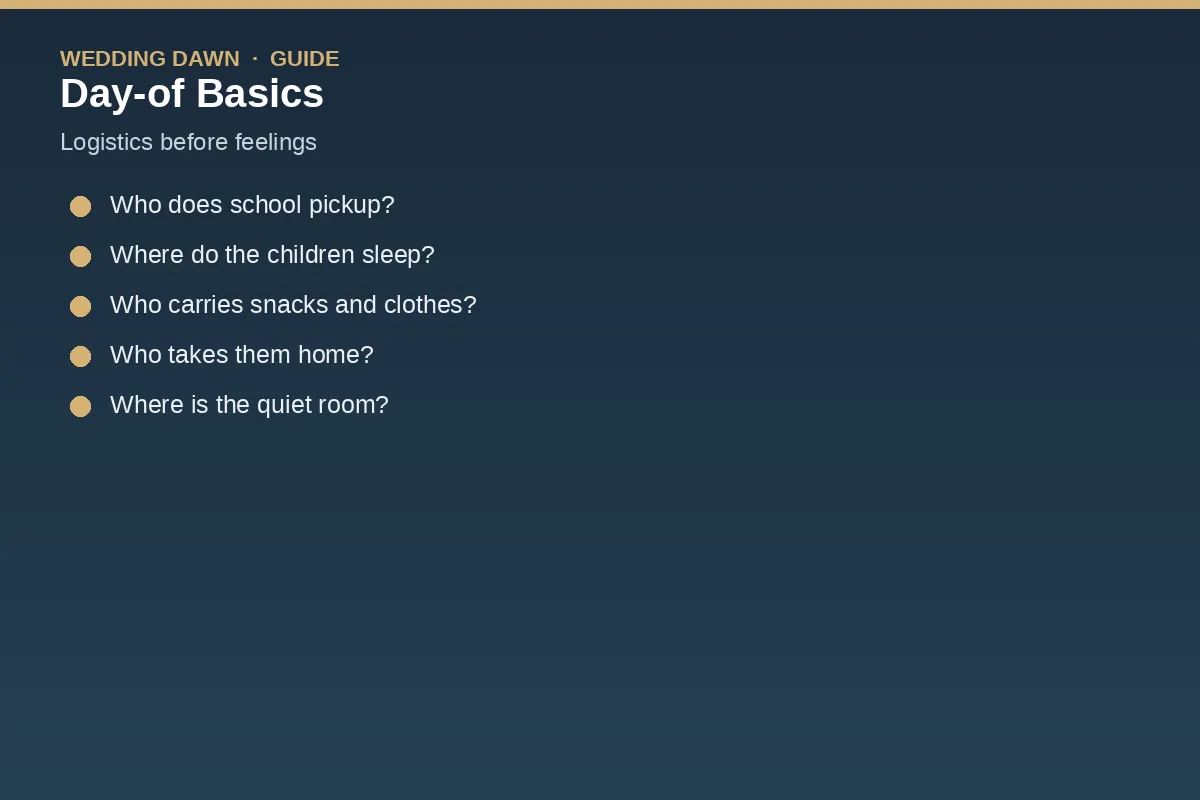
The wedding day is a schedule problem before it is an emotional one. Decide who does school pickup, who has the children the night before, who brings the bag with snacks and a change of clothes, and who takes them home if the reception runs late. Put it in a shared note with the planner and the other parent. If a child has a medical or sensory need, tell the venue and the planner, not just the babysitter.
Build in a quiet room and a transition point. Most children can manage a long day if they know when the loud part ends and where they can go. A cousin, an aunt, or a hired sitter can cover the gap between the ceremony and dinner. And plan the goodbye: a child leaving early should be able to say goodnight to the couple without waiting in a queue of well-wishers.
- Write the day's custody and pickup schedule down.
- Pack snacks, a change of clothes, and any medication.
- Book a quiet room and an adult to cover the gap.
- Let children say goodnight without waiting in line.
Step by step
Talk to each child
Ask what they know, want, and worry about; do not assign roles yet.
Choose one real job each
Reading, rings, standing beside you, or helping a younger sibling.
Write the family vow
Concrete promises about routines and security, under a hundred words.
Plan seating around trust
Seat children with the adult they are most settled with; brief the planner.
Lock the logistics
Custody, pickup, snacks, quiet room, and a named adult for each child.
Quick checklist
- Each child has been asked, not told.
- Roles are optional and age-appropriate.
- One adult is responsible for each child during the ceremony.
- Family vow written and read by the adults.
- Officiant knows how the family will be acknowledged.
- Seating keeps separated parents at different tables.
- Children's table has an assigned adult.
- Speakers briefed on what not to say.
- Photo list includes names and relationships.
- Pickup and quiet-room plan shared with the planner.
FAQ
Should the children call the wedding a 'new family'?
Let them use their own words. The adults can describe the marriage; the children should not be asked to narrate a family identity they are still living.
Do we need a family vow?
No, but it is a clear way to acknowledge the children. Keep it short, concrete, and about their daily life rather than the adults' feelings.
How do we seat both biological parents?
At different tables, each with a clear view of the children and a known route to them. Tell the planner who may take a child out of the room and when.
What if a child does not want to be in photos?
Respect it. Take the photos they agree to and skip the staged family portrait. A child's discomfort is not a detail to Photoshop out later.
Should we invite the other parent?
Only if the relationship supports it and the child wants it. There is no obligation. If they attend, brief the planner and keep the seating plan simple.
Sources
- NIST — Privacy Framework Handling children's images and personal data, reviewed 2026-11.
- ADA National Network — Accessibility Sensory and accessibility needs at family events, reviewed 2026-11.
- Emily Post Institute — Etiquette advice Seating and family etiquette, reviewed 2026-11.