When to Send Wedding Invitations
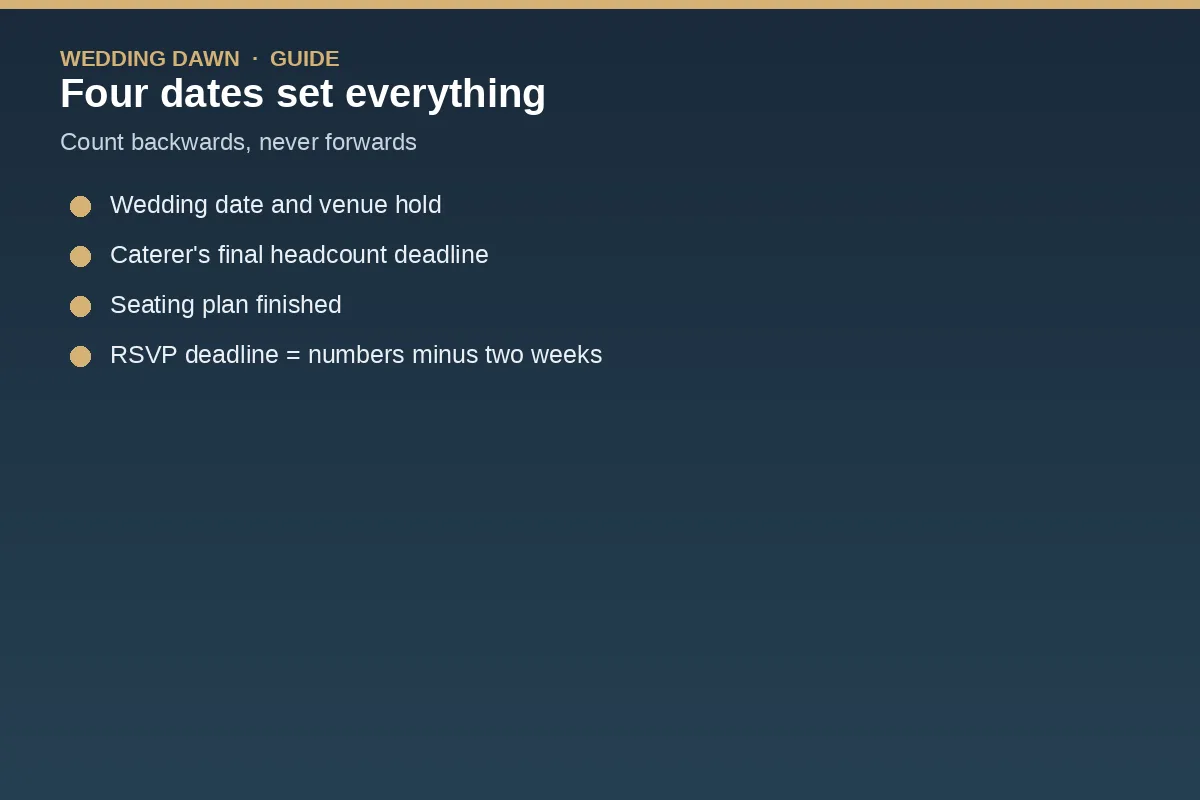
Most invitation stress comes from treating the card as the starting point. It is not. The invitation is the last step in a chain that begins with your venue hold, your caterer's final headcount deadline and the date your seating plan has to be finished. Once those three dates are fixed, the rest is arithmetic: work backwards, add a buffer for the postal service, and put every deadline on one calendar that both of you can see. Couples who do this usually discover they have more time than they feared, and couples who skip it end up paying for rush printing and guessing at numbers.
The short answer for a typical Saturday wedding is: save-the-dates nine to twelve months ahead, invitations eight to ten weeks before the day, an RSVP deadline four weeks out, final numbers to the caterer two to three weeks out, and seating finished ten to fourteen days before. Destination weddings, holiday weekends and peak-season venues each push those numbers earlier. The rest of this guide explains how to adjust them without guessing, and where the expensive mistakes hide.
The timeline at a glance
Treat this as a default you then correct for your own venue, not a rule you follow blindly. The weeks are counted backwards from the wedding day, because that is the only fixed point everyone shares.
- 12 months out: lock the date and venue, and write the caterer's final-count deadline into your own calendar.
- 9 to 12 months out: send save-the-dates, especially if guests must book flights.
- 6 months out: book room blocks, publish the wedding website, and remind guests about passport validity.
- 10 to 12 weeks out: order invitations, print envelopes, and buy postage after weighing a complete assembly.
- 8 to 10 weeks out: mail the invitations. Go to 12 weeks for destination or holiday-weekend weddings.
- 4 weeks out: RSVP deadline. Start chasing non-responders in writing the next morning.
- 3 weeks out: final headcount to the caterer and venue, including vendor meals.
- 2 weeks out: finish the seating plan, place cards and the supplier schedule.
- 1 week out: confirm every supplier in writing, pack the box, and stop adding names.
Save the date is not an invitation
A save-the-date is a logistical warning, not an invitation, and the difference matters. It should carry your names, the date and the city, and nothing that assumes a reply. It does not need a registry, a dress code or a menu choice. Its only job is to let people book flights and request leave before prices climb. Send it to people you are certain will be invited, because a save-the-date is a promise; withdrawing one later is a relationship cost you cannot invoice.
If your guest list is still moving, send in waves rather than guessing. A smaller first wave protects you from awkward corrections, and nobody compares notes as carefully as couples fear. Digital save-the-dates are fine for local guests and short timelines, while paper still earns its postage for international families and older relatives who keep things on the fridge.
Work backwards from the RSVP deadline
Your RSVP date is not chosen for etiquette; it is chosen by the caterer. Take the date the caterer needs final numbers, subtract a week for the seating plan, and subtract another ten days to two weeks for chasing people who ignored the first request. That usually lands four to five weeks before the wedding. If your caterer wants numbers twenty-one days out, an RSVP deadline thirty-five days out is not early; it is the minimum that lets you use the information.
Then add postal time in both directions. Mailing eight to ten weeks before the wedding leaves two to three weeks for delivery and another three to four for replies, which is comfortable without being so early that guests lose the card. Put the deadline on a weekday rather than a Sunday, because people deal with admin at work or on a lunch break, not in the middle of a weekend. If you use a website, show the deadline on the first screen instead of burying it in a tab.
Keep one spreadsheet as the single source of truth. Columns that earn their place: invited, address confirmed, sent, replied, meal choice, allergies, plus-one, transport needed, and notes. Two lists in two places guarantees that somebody gets counted twice or not at all, and the caterer will charge you for the version you sent, not the version you meant.
Destination, holiday and short-notice weddings
For a destination wedding, send invitations twelve weeks before the day and save-the-dates twelve months before. Guests need time to price flights, check passports and arrange leave, and a late invitation turns a generous invitation into a guilty no. Add two weeks if your date falls on a holiday weekend, when hotels fill and airports behave badly. Venues in peak season often want final numbers earlier than you expect, so read the contract before you choose the RSVP date.
Short engagements compress the front half, not the back half. Skip save-the-dates, send invitations immediately, and use digital replies for speed. Do not shrink the RSVP window below three weeks, because late replies are not rudeness so much as ordinary life. If you are marrying in under three months, call the people you most need rather than relying on paper, and accept that some guests will decide late.
Paper, digital, and what guests actually read
Paper still sets a tone that a link cannot, and it is kinder to older guests who do not live in their inbox. Digital invitations suit short timelines, international guests and anyone who wants replies tracked automatically. The hybrid that works best for most couples is a paper invitation with a QR code to the RSVP page, so the object stays on the mantel while the data lands in one place.
Whichever route you choose, the invitation must answer six questions without help: who is getting married, when, where, what to wear, how to reply, and by when. Directions, accommodation and registry belong on an insert or the website, not crammed onto the main card. Do not print a registry on the invitation itself in most English-speaking markets; it reads as a bill. And never put a registry on a save-the-date.
The mistakes that cost real money
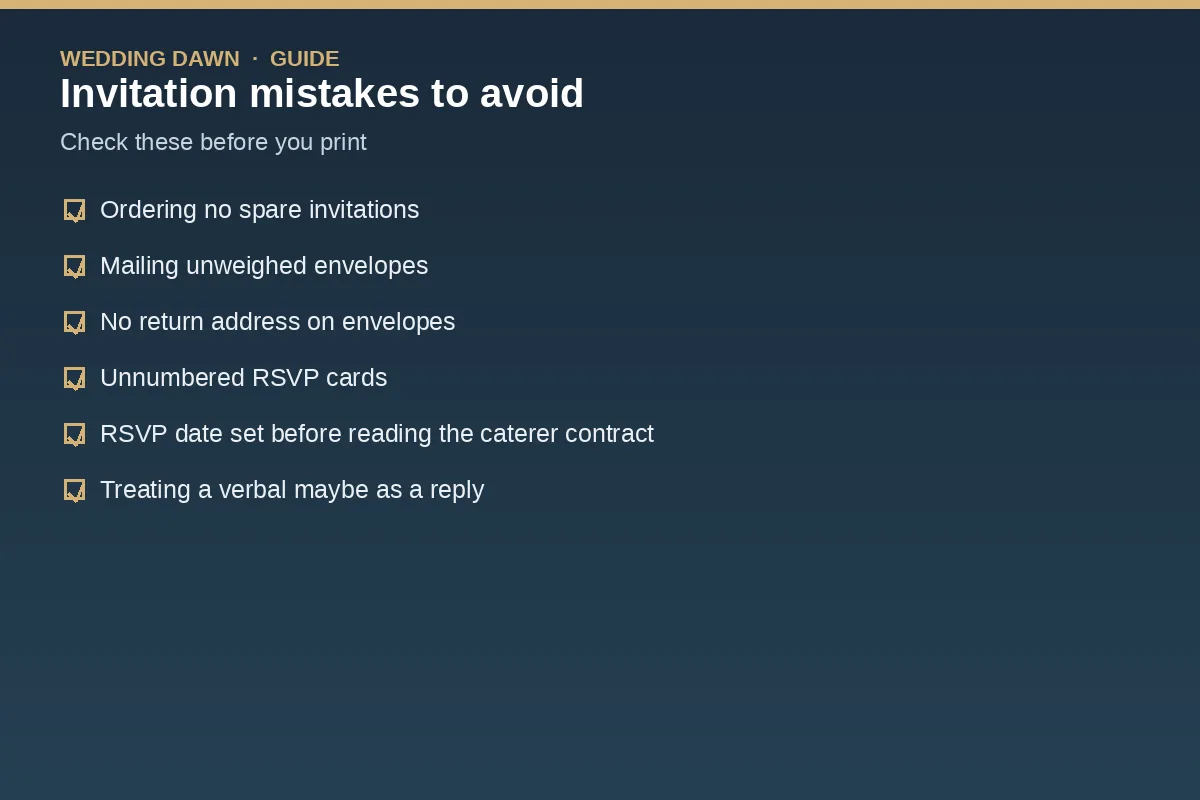
Order ten to fifteen percent more invitations than your guest count, because envelopes get ruined, addresses change and one cousin always needs a second copy. Weigh a complete assembly at the post office rather than trusting the stated rate, especially with wax seals, ribbons or heavy card stock. Put a return address on every envelope, and number the back of each RSVP card so you can identify the reply that arrives with no name.
The most expensive mistake is choosing an RSVP date before reading the catering contract. The second most expensive is treating verbal enthusiasm as a reply. A guest who says they will probably come has not chosen a meal, and the caterer cannot cook a probability. Chase in writing, keep the replies you actually have, and build the seating plan from confirmed numbers only.
The final month, in order
Four weeks out, send a short reminder to everyone who has not replied, with the deadline and the link. Three weeks out, send final numbers and confirm vendor meals. Two weeks out, finish the seating plan, print place cards and send the schedule to every supplier. One week out, confirm arrival times in writing and stop editing the list. If a late reply arrives after the numbers are in, welcome the guest and seat them at the table with the most room; do not rebuild the room for one person.
B-lists need care rather than secrecy. Send a second-wave invitation only after a confirmed decline, never before, and never to someone who will discover they were a backup. If that sounds like too much administration, the honest alternative is a smaller list from the start.
The honest test
An invitation is a logistics document that happens to be beautiful. If a guest can answer who, when, where, what to wear, how to reply and by what date without opening another tab, it works. If they have to text you to ask, the design has failed no matter how good the typography looks. Get the dates right, print one extra batch, and spend the saved energy on the people who are actually coming.
How to build your invitation timeline
Find the three fixed dates
Write down the wedding date, the caterer's final headcount deadline and the day your seating plan must be finished. Everything else is calculated from these.
Set the RSVP deadline backwards
Subtract one week for seating and ten to fourteen days for chasing from the caterer's deadline. A four-to-five-week-out RSVP date is normal, not early.
Mail eight to ten weeks ahead
Add two weeks for destination or holiday-weekend weddings, and weigh a complete invitation at the post office before buying stamps.
Send save-the-dates nine to twelve months ahead
Names, date and city only. Send them only to guests you are certain to invite, and use them to prompt passport and leave checks.
Track replies in one sheet
Record invited, sent, replied, meal, allergies, plus-one and transport. Chase non-responders in writing the morning after the deadline.
Quick checklist
- Venue and date confirmed in writing
- Caterer's final-count deadline written into the calendar
- RSVP deadline set four to five weeks before the wedding
- Save-the-dates sent nine to twelve months ahead
- Guest addresses collected and checked
- Invitations ordered ten to fifteen percent over the guest count
- A complete invitation weighed at the post office
- Return address printed on every envelope
- RSVP cards numbered on the back
- Website live with travel, dress code and registry details
- Reminder message drafted before the deadline passes
- Final numbers and vendor meals confirmed three weeks out
FAQ
How far in advance should wedding invitations be sent?
Eight to ten weeks before the wedding for most local weddings, and twelve weeks for destination or holiday-weekend weddings. The save-the-date goes out nine to twelve months ahead and carries only names, date and city.
When should the RSVP deadline be?
Four to five weeks before the wedding for a typical venue. Work backwards: the caterer's final-count deadline, minus a week for seating, minus ten to fourteen days for chasing. Never set it later than three weeks out unless the caterer agrees in writing.
Is a digital invitation acceptable?
Yes, especially for short timelines and international guests, as long as it states the same details and tracks replies. Many couples use paper with a QR code so older guests get something physical and replies still land in one system.
What happens if guests do not reply?
Send one short written reminder the day after the deadline, then call the people you genuinely need to count. Assume silence means no for catering purposes, and tell them warmly that you will miss them rather than chasing a third time.
Should we include registry information?
Not on the invitation in most English-speaking markets, and never on a save-the-date. Put it on the website or a separate insert, and let close family share it when asked.
How many extra invitations should we order?
Ten to fifteen percent more than your confirmed guest count. Envelopes get damaged, addresses change and a few guests will need replacements; reprints are far more expensive than a small overrun.
Sources
- Royal Mail — Wedding invitations and postage Guidance on weighing assembled invitations and allowing delivery time; checked 2026-11.
- USPS — How to send wedding invitations Postage, addressing and non-machinable surcharge rules referenced in the mailing section; checked 2026-11.
- The Knot — Wedding planning timeline Common benchmark windows for save-the-dates, invitations and RSVPs; checked 2026-11.